From CAD to Casting: Why Production-Ready 3D Jewelry Design Matters Before Manufacturing
In modern jewelry production, a beautiful design is only the beginning. A ring, pendant, bracelet, or custom jewelry piece may look impressive in a concept image, but if the 3D jewelry CAD design is not built correctly, it can create serious problems during casting, stone setting, polishing, and final assembly.
This is where production-ready jewelry CAD becomes essential.
For jewelry brands, independent jewelers, manufacturers, and private clients, professional jewelry CAD modeling is not just about creating a digital model. It is about developing a precise, manufacturable file that can move from idea to 3D printing, casting, stone setting, and finishing with fewer risks. A strong CAD file helps protect the design, control the weight, improve stone accuracy, reduce production mistakes, and give the client a clear visual understanding before the jewelry is made.
At CADVANCE, our work focuses on custom jewelry CAD, realistic jewelry rendering, idea development, and digital jewelry manufacturing support. The goal is not only to make jewelry look beautiful on screen, but to prepare it correctly for real production.
What Does “Production-Ready Jewelry CAD” Mean?
Production-ready jewelry CAD means that the 3D model is designed with manufacturing in mind. It is not only a visual file. It is a technical design prepared for practical use in the jewelry workshop.
A production-ready CAD file should consider:
- Correct wall thickness
- Proper stone seats
- Safe prong sizes
- Realistic metal weight
- Comfortable wearability
- Casting shrinkage
- Polishing allowance
- 3D printing limitations
- Clean surfaces and solid geometry
- Correct file formats such as 3DM and STL
A model can look attractive in a render but still fail in production if these details are ignored. For example, prongs may be too thin to hold stones safely, galleries may be too weak, the ring may be too heavy for the target budget, or small details may disappear during casting and polishing.
Professional 3D jewelry CAD design helps solve these problems before money is spent on production.
Why CAD Quality Affects the Final Jewelry Piece
Jewelry manufacturing is a chain of connected steps. If the CAD file is weak, every following step becomes more difficult. A small CAD mistake can become a major issue after 3D printing, casting, setting, or polishing.
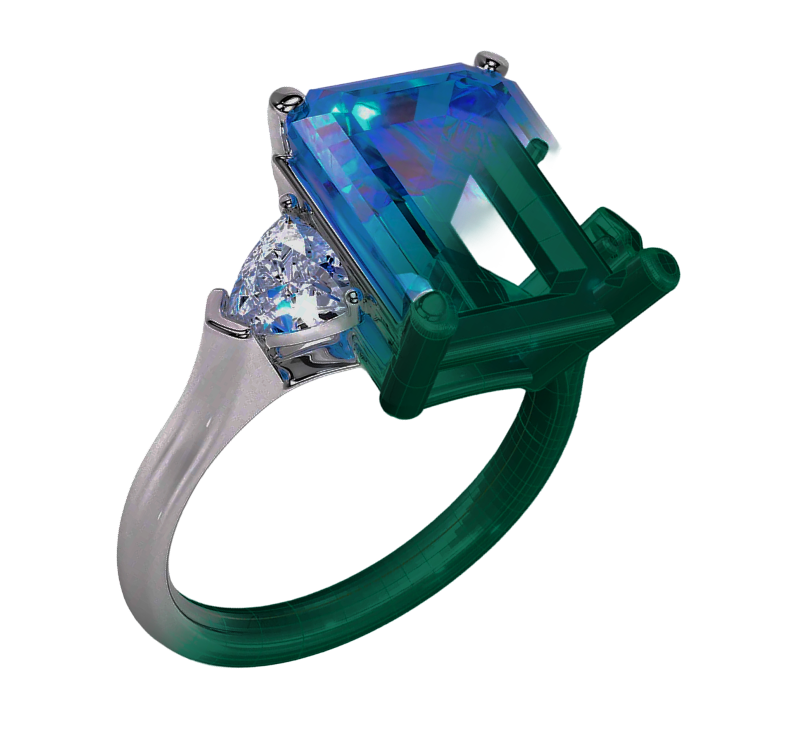
For example, in engagement ring CAD design, the center stone seat must match the stone dimensions accurately. The prongs must be strong enough to hold the stone but not so bulky that they ruin the elegance of the design. Side stones need proper spacing, depth, and setting structure. The shank must be comfortable, balanced, and suitable for long-term wear.
In pendant CAD modeling, especially for iced-out pendants or custom name pendants, stone spacing, letter thickness, bail strength, and back structure are all important. If the CAD model is created only for appearance, the final pendant may be fragile, uncomfortable, or difficult to set.
This is why experienced jewelry CAD services focus on both aesthetics and manufacturing logic.
CAD to Casting: Where Many Problems Begin
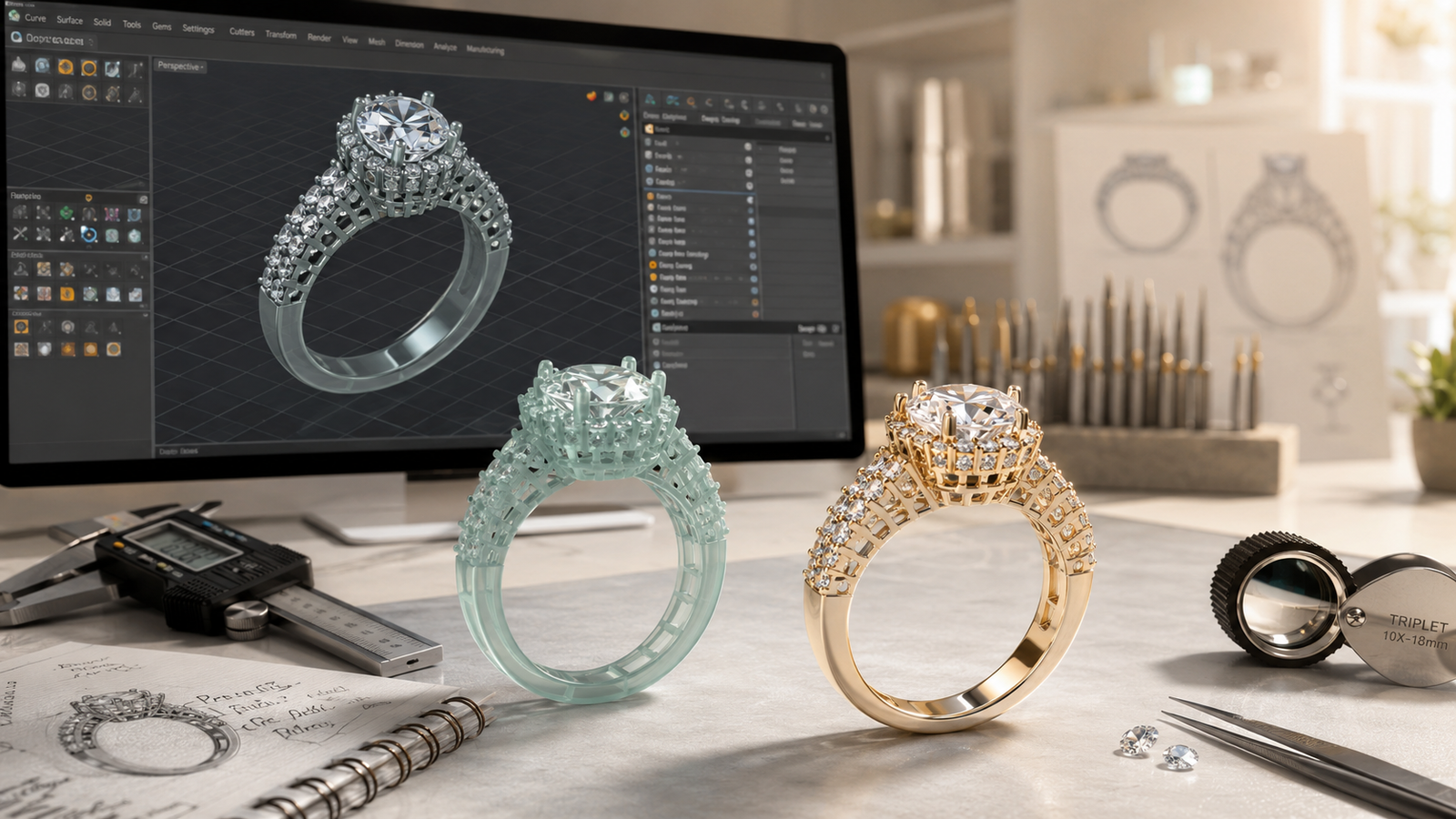
The CAD to casting process is one of the most important stages in digital jewelry manufacturing. A 3D model is usually printed in resin or wax, then used for investment casting. During this process, the design must survive printing, burnout, casting, cleaning, and polishing.
If the CAD file has extremely thin details, unsupported areas, weak connections, or unrealistic stone settings, the final cast can have defects. Common issues include:
- Broken prongs
- Porosity in weak sections
- Loss of small decorative details
- Warped thin areas
- Difficult stone setting
- Extra labor during cleanup
- Incorrect ring size after finishing
- Unbalanced metal weight
A professional jewelry design studio considers these risks from the beginning. This does not mean making every design thick and heavy. It means finding the right balance between beauty, durability, comfort, and production safety.
The Difference Between a Visual 3D Model and a Jewelry CAD Model
Not every 3D model is a jewelry CAD model. This is an important distinction for jewelry brands and clients to understand.
A general 3D artist may be able to create a beautiful object, but jewelry CAD modeling requires knowledge of real jewelry production. The model must be suitable for stone setting, casting, polishing, and wearing on the body.
A visual model may be good for presentation, but a professional jewelry CAD file must answer technical questions:
Will the stones fit correctly?
Are the prongs strong enough?
Is the ring comfortable inside?
Will the design cast properly?
Is the model too heavy or too fragile?
Can the jeweler polish it without damaging details?
Can the file be printed cleanly?
These questions are especially important for fine jewelry, engagement rings, custom pendants, signet rings, floral designs, and luxury jewelry collections.
How 3D Jewelry CAD Design Helps Jewelry Brands
For jewelry brands, CAD is not only a production tool. It is also a business tool.
A strong 3D jewelry CAD design workflow helps brands develop collections faster, test new ideas before manufacturing, and present designs to clients or investors with more confidence. Instead of producing physical samples for every concept, brands can first develop accurate digital models and photorealistic jewelry renders.
This saves time, reduces production costs, and improves decision-making.
For example, a luxury jewelry startup may want to develop a new engagement ring collection. With professional custom jewelry CAD services, the brand can create multiple ring variations, compare stone sizes, adjust proportions, review metal colors, and approve the final model before production begins.
This is much more efficient than relying only on sketches or physical prototypes.
The Role of Jewelry Rendering in the CAD Workflow
3D jewelry rendering is another important part of the digital jewelry manufacturing process. A CAD file shows the structure of the design, but a realistic render helps clients understand how the final piece may look in real life.
Photorealistic jewelry renders can show:
- Yellow gold, white gold, rose gold, or platinum appearance
- Diamond and gemstone brilliance
- Surface finishes such as high polish, matte, or texture
- Stone layout and proportions
- Design presentation for websites, catalogs, and client approval
For jewelry brands, jewelry rendering services are useful before production and after production. Before manufacturing, renders help clients approve the design. After approval, high-quality images and videos can support marketing, e-commerce, social media, and collection presentations.
A strong workflow often includes both production-ready jewelry CAD and realistic jewelry rendering. One supports manufacturing; the other supports communication and sales.
Why Stone Setting Must Be Planned in CAD
Stone setting is one of the most technical parts of jewelry design. Whether the piece includes a large center stone, pavé diamonds, channel-set stones, bezel settings, or an iced-out surface, the CAD model must be prepared with setting accuracy.
In professional jewelry CAD modeling, stone seats must be created with the correct depth, spacing, and metal support. Prongs must be designed according to stone size and setting style. Small diamonds need enough metal around them to stay secure after casting and polishing.
If stone setting is not planned correctly in CAD, the setter may struggle during production. This can lead to loose stones, broken prongs, uneven settings, or extra labor costs.
For engagement ring CAD design, this is especially important because the final piece must be elegant, secure, and comfortable for daily wear. For pendant CAD modeling, it is important because many pendants include dense stone layouts, complex letters, and decorative surfaces.
Custom Jewelry CAD: Turning Ideas into Manufacturable Designs
Many clients begin with a sketch, reference photo, old jewelry piece, or simple idea. Custom jewelry CAD helps transform that idea into a precise digital model.
The process usually includes:
- Understanding the design concept
- Developing proportions and structure
- Choosing stone sizes and layout
- Building the 3D CAD model
- Checking manufacturing details
- Preparing renders for approval
- Delivering production-ready 3DM/STL files
This workflow is valuable for both simple and complex designs. A clean solitaire ring, a detailed floral engagement ring, a sculptural signet ring, or a custom pendant all require different technical decisions.
Good CAD does not remove creativity. It protects creativity by making the design possible to manufacture.
3D Printing for Jewelry and File Preparation
3D printing for jewelry has become a standard part of modern production, but the print quality depends heavily on the CAD file. A clean STL file helps the printing process produce accurate results.
Before sending a file for 3D printing, the CAD model should be checked for:
- Watertight geometry
- Correct scale
- Smooth surfaces
- No unwanted intersections
- Proper detail thickness
- Clean stone seats
- Suitable supports if required by the printer
A poor file can create failed prints, rough surfaces, or inaccurate dimensions. This is why digital jewelry manufacturing support is important. The designer must understand not only how the model looks, but how it will behave in the real production process.
Why Professional CAD Saves Time and Money
Some businesses try to save money by choosing the cheapest CAD model possible. But in jewelry manufacturing, a cheap file can become expensive later.
A weak CAD model can lead to:
- Multiple revisions
- Failed prints
- Casting issues
- Extra bench work
- Stone setting problems
- Delayed client delivery
- Higher production costs
- Lower final quality
Professional jewelry CAD services help reduce these risks. A well-built CAD file may cost more at the beginning, but it can save time, protect the client’s budget, and improve the final result.
For jewelry brands and manufacturers, this is especially important because production mistakes affect reputation. Clients expect quality, accuracy, and reliability. CAD is the foundation of that result.
Building Trust Through a Better Digital Workflow
A professional jewelry CAD design studio should do more than create files. It should guide clients through the digital design process with clarity.
This includes understanding the client’s design goal, explaining technical limitations, preparing accurate models, providing realistic jewelry renders, and delivering files that are ready for production.
For clients, this creates confidence. They can see the design before production, request revisions before casting, and understand how the final piece will look and function.
For jewelry businesses, this creates a stronger workflow from design to manufacturing.
Conclusion: Better CAD Creates Better Jewelry
Production-ready 3D jewelry CAD design is one of the most important steps in modern jewelry manufacturing. It connects creativity with technical accuracy and helps transform ideas into real, wearable, high-quality jewelry.
A strong CAD file supports casting, stone setting, 3D printing, polishing, rendering, and client approval. It reduces risk, improves communication, and helps jewelry brands bring custom designs to market with more confidence.
For jewelry brands, manufacturers, designers, and private clients, professional jewelry CAD modeling is not just a digital service. It is the foundation of better jewelry production.
If you are developing a custom ring, pendant, engagement ring, or jewelry collection, CADVANCE provides 3D jewelry CAD design, production-ready 3DM/STL files, photorealistic jewelry renders, sketching, idea development, and digital jewelry manufacturing support.
FAQ
What is 3D jewelry CAD design?
3D jewelry CAD design is the process of creating a precise digital model of a jewelry piece using specialized software. The model can be used for visualization, rendering, 3D printing, casting, and manufacturing.
What makes a jewelry CAD file production-ready?
A production-ready jewelry CAD file includes correct dimensions, safe wall thickness, proper stone seats, clean geometry, realistic metal structure, and export formats such as 3DM or STL for manufacturing.
Why is CAD important before casting jewelry?
CAD helps identify and solve design problems before casting. It allows the jeweler or manufacturer to check proportions, stone placement, prongs, thickness, weight, and overall structure before production begins.
Can jewelry rendering help before manufacturing?
Yes. Photorealistic jewelry rendering helps clients see the design before production. It is useful for approvals, marketing, online catalogs, social media, and collection presentations.
Is CAD useful for custom engagement rings?
Yes. Engagement ring CAD design allows accurate control over the center stone, side stones, prongs, shank, gallery, comfort, and final proportions before the ring is manufactured.
What file formats are usually needed for jewelry manufacturing?
Common jewelry CAD file formats include 3DM for editable modeling and STL for 3D printing and casting preparation. Some manufacturers may also request additional formats depending on their workflow.