Stone Setting Accuracy in Jewelry CAD: Why Precision Matters Before Production
In fine jewelry manufacturing, stone setting is one of the most delicate and important stages of production. A design can look beautiful in a render, but if the stones are not planned correctly in the CAD model, the final piece may become difficult to manufacture, unsafe to wear, or expensive to correct.
This is why professional 3D jewelry CAD design must go beyond visual appearance. A high-quality jewelry CAD model should consider how every diamond, gemstone, prong, bezel, channel, or pavé detail will work in real production. For jewelry brands, manufacturers, engagement ring companies, and custom jewelry clients, accurate stone setting in CAD can protect the design from costly mistakes before casting, 3D printing, and final setting begin.
At CADVANCE, jewelry CAD modeling is approached as both a creative and technical process. The goal is to create elegant designs that are not only visually attractive, but also practical for manufacturing, stone setting, polishing, and long-term wear.
Why Stone Setting Starts in the CAD Model
Stone setting does not begin at the jeweler’s bench. It begins much earlier, during the digital design stage.
When a jewelry design studio creates a CAD model, the stone layout must be planned with accurate measurements, correct spacing, and suitable metal support. This is especially important for engagement ring CAD design, diamond bands, tennis bracelets, halo rings, iced-out pendants, custom name pendants, and luxury jewelry collections.
If the CAD model is prepared correctly, the setter receives a piece that is easier to work with. The stones sit properly, the prongs have enough strength, and the design keeps its intended shape after casting and polishing.
If the CAD model is weak, the setter may face problems such as loose stones, uneven seats, broken prongs, poor alignment, or metal that is too thin to hold the stones securely.
Professional custom jewelry CAD helps prevent these issues before production begins.
The Difference Between Decorative Stones and Settable Stones
In a simple visual model, stones may be placed only for appearance. They may look attractive in a 3D jewelry rendering, but that does not mean they are ready for real setting.
In production-ready jewelry CAD, every stone must be treated as a physical object with real dimensions. The CAD designer must consider the stone diameter, depth, shape, pavilion, table, girdle, and setting method. A 1.2 mm diamond, a 2.5 mm round stone, a marquise center stone, and an emerald-cut gemstone all require different seat structures.
A stone cannot simply be placed on a surface. It needs space, support, and access for the setter’s tools.
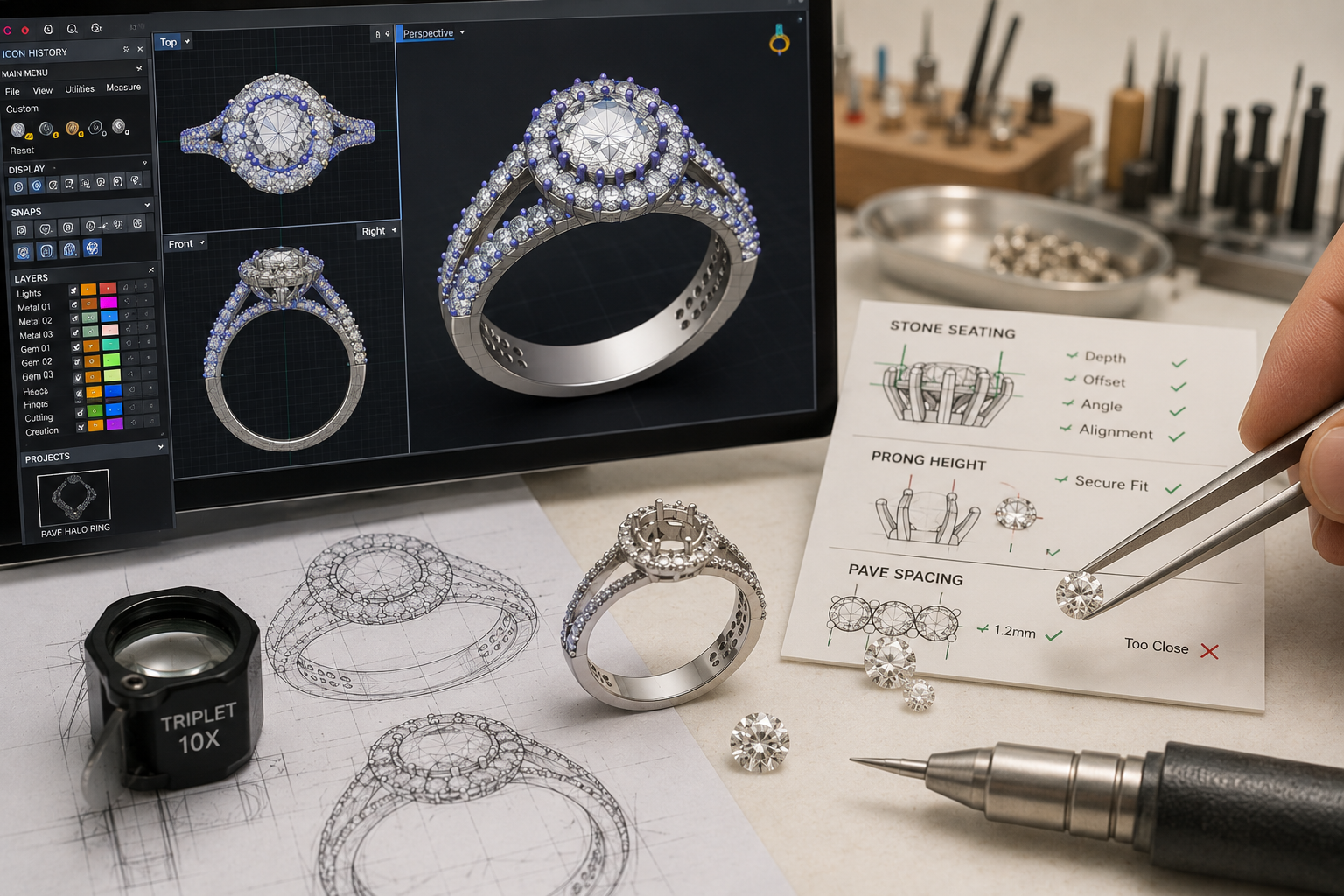
For example, in pavé jewelry CAD modeling, the stones must have enough metal between them so the beads or prongs can be formed after casting. In a bezel setting, the wall must be thick enough to close over the stone but not so heavy that it ruins the elegance of the design. In a prong setting, the prongs must be strong enough to secure the stone while still looking refined.
This balance is one of the main reasons professional jewelry CAD services are important.
Common Stone Setting Problems Caused by Poor CAD
Many production problems happen because the CAD file was created without enough manufacturing knowledge. The model may look impressive on screen, but once it is printed, cast, and prepared for setting, the weaknesses become visible.
Common CAD-related stone setting problems include:
- Stones placed too close together
- Prongs that are too thin or too short
- Seats that are too shallow or too deep
- Weak metal between pavé stones
- Gemstones floating without proper support
- Settings that are impossible to access with tools
- Uneven stone alignment
- Heavy metal areas that make the design uncomfortable
- Fragile details that break during polishing
- Incorrect stone sizes compared to the actual stones
These issues can create extra labor, delays, and sometimes the need to remake the model completely.
A skilled jewelry CAD design studio understands that the CAD file is not only a digital preview. It is the foundation of the entire manufacturing process.
Engagement Ring CAD Design and Center Stone Accuracy
Engagement rings require a particularly high level of accuracy. The center stone is usually the most important and valuable part of the piece, so its seat must be planned carefully.
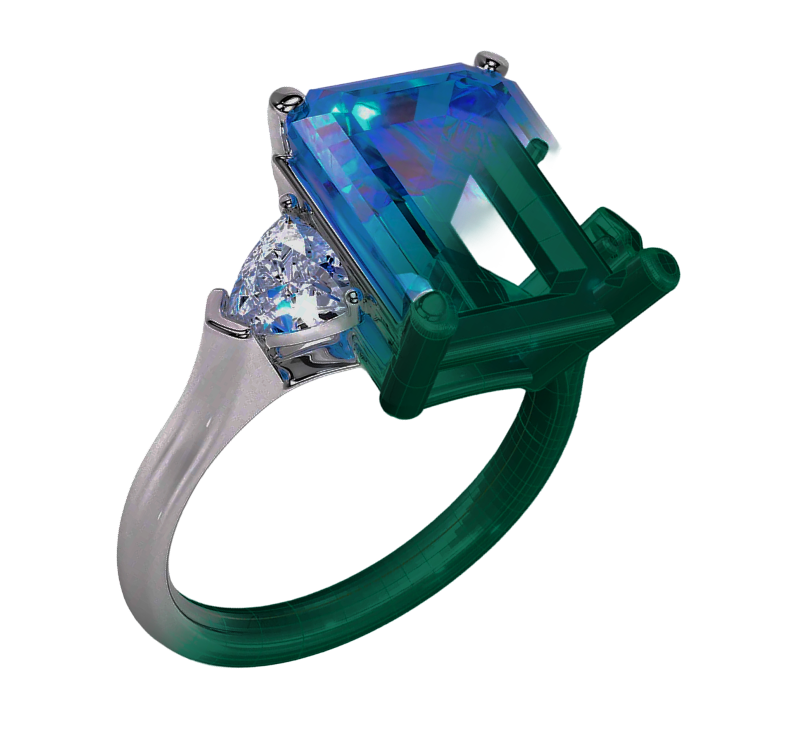
In engagement ring CAD design, the CAD model should consider the exact stone size and shape. A round brilliant diamond, oval diamond, pear-shaped gemstone, emerald cut, cushion cut, or marquise stone will each require different support and different prong placement.
The center stone setting must be secure, but the design also needs to remain elegant. If the prongs are too thick, the ring can look heavy. If they are too thin, the stone may not be safe. If the seat is not correct, the stone may sit too high, too low, or at the wrong angle.
The gallery, bridge, side stones, halo, and shank must all work together. A beautiful engagement ring is not only about the front view. It must be comfortable from the inside, balanced from the side, and strong enough for daily wear.
Pavé, Halo, and Small Diamond Layouts
Small diamonds create beauty, sparkle, and luxury, but they also create technical challenges. Pavé, halo, and micro-stone designs require careful planning in CAD because the setting area is often very limited.
For small stones, even a tiny mistake in spacing can affect the final result. If stones are too close, there may not be enough metal to form secure beads or prongs. If they are too far apart, the design may look empty or uneven. If the surface is too thin, the stones may not stay secure after setting.
In professional jewelry CAD modeling, small stones should be arranged with attention to:
- Stone diameter
- Distance between stones
- Metal thickness under stones
- Prong or bead placement
- Surface curvature
- Casting and polishing allowance
- Final visual symmetry
This is especially important in custom jewelry CAD projects such as diamond pendants, name pendants, championship rings, tennis bracelets, and detailed luxury rings.
For jewelry manufacturers, a clean pavé layout can save significant time during stone setting.
Pendant CAD Modeling and Stone Setting Challenges
Pendant CAD modeling often includes different technical challenges compared to rings. Pendants may have lettering, symbols, logos, sculptural surfaces, or large areas covered with diamonds. Because pendants are usually seen from the front, clients often want strong visual impact. But behind that front view, the structure must still be strong and manufacturable.
In iced-out pendants, stone setting accuracy is critical. The CAD designer must plan stone sizes, rows, borders, bail strength, back structure, and total metal weight. If the pendant is too thin, it may bend or feel weak. If it is too heavy, it may become uncomfortable or too expensive to produce.
The bail also needs attention. It must be strong enough to support the pendant and large enough for the intended chain. Many pendant problems happen not in the main design, but in small technical areas such as the bail, connections, or thin letter sections.
A professional jewelry design studio considers these details during the CAD stage, before the piece is sent for 3D printing or casting.
CAD, 3D Printing, and Casting: Why Tolerances Matter
A jewelry CAD model must account for the real production process. After the CAD file is complete, it may be exported as an STL file for 3D printing. The printed model then goes through casting, cleanup, stone setting, and polishing.
During these steps, small changes can happen. Surfaces may need cleanup. Metal may shrink slightly. Prongs may require finishing. Edges may soften during polishing. This is why tolerance is important.
In digital jewelry manufacturing, tolerances help ensure that the final piece remains close to the approved design after production. If the CAD model is too thin or too tight, the final result may lose quality. If the model is too bulky, it may become heavy, expensive, or unattractive.
Production-ready jewelry CAD should leave enough room for real workshop processes without sacrificing the beauty of the design.
How Jewelry Rendering Supports Stone Setting Approval
3D jewelry rendering is not only useful for marketing. It also helps clients and brands review stone layout before production.
A photorealistic jewelry render can show the relationship between stones, metal, proportions, and surface finish. It helps the client understand whether the halo looks balanced, whether the center stone sits correctly, or whether the pavé layout gives the desired level of brilliance.
For jewelry brands, jewelry rendering services are valuable because they make approval easier. Instead of explaining every technical detail verbally, the studio can present clear visuals that show the design before it is manufactured.
However, rendering should be based on a strong CAD model. A beautiful render created from a weak model can mislead the client. The best workflow combines accurate 3D jewelry CAD design with realistic visualization.
https://cadvance.pro/service/photorealistic-jewelry-rendering/
Why Jewelry Brands Need Technical CAD Partners
Jewelry brands often focus on style, identity, and customer experience. Manufacturers focus on production. A professional CAD partner connects both sides.
A strong jewelry CAD design studio understands the creative goal of the brand, but also the technical requirements of manufacturing. This makes the design process smoother and more reliable.
For example, a brand may want a delicate diamond ring that looks light and elegant. The CAD designer must keep the design refined while still making sure the prongs, gallery, shank, and stone seats are safe. Another brand may want a bold custom pendant with many diamonds. The CAD designer must create visual impact while controlling weight, structure, and setting practicality.
This is where professional jewelry CAD services become valuable. They help turn ideas into files that can actually be produced.
Better Stone Setting Starts with Better CAD
Accurate stone setting in CAD improves the entire jewelry production workflow. It helps reduce mistakes, protect valuable stones, support the setter, and create a better final product.
For jewelry brands, manufacturers, custom designers, and private clients, this means fewer surprises during production. The design can be reviewed, adjusted, rendered, and approved before casting begins.
Professional 3D jewelry CAD design is not just about making a model. It is about building a reliable foundation for manufacturing. When the CAD file is accurate, the stone setting process becomes safer, cleaner, and more efficient.
At CADVANCE, we provide custom jewelry CAD, production-ready 3DM/STL files, CAD to casting preparation, engagement ring CAD design, pendant CAD modeling, jewelry sketching, idea development, and photorealistic jewelry rendering services. Our goal is to help jewelry businesses and clients move from concept to production with clarity, precision, and confidence.