Engineering Enamel and Inlay Jewelry in CAD: Color, Fit, and Manufacturing Precision
Color in fine jewelry is not created only by gemstones. Enamel, mother-of-pearl, ceramic, lacquer, resin, hardstone, and decorative inlays can transform a metal surface into a more expressive composition. They introduce contrast, symbolism, pattern, and brand identity without depending entirely on faceted stones.
From a design perspective, these materials may appear to be surface decoration. From a manufacturing perspective, they change the construction of the jewelry itself.
An enamel-filled pendant needs recessed areas with controlled depth, clean borders, and enough access for application and finishing. A hardstone inlay must fit a precisely prepared seat while allowing for cutting, polishing, adhesive, and material fragility. A ceramic insert may require mechanical retention rather than relying only on bonding. Mother-of-pearl must be supported without placing damaging pressure on its thin edges.
These requirements must be considered during 3D jewelry CAD design, not after the metal has already been cast.
Professional jewelry CAD modeling allows designers and manufacturers to define where color belongs, how inserts will be held, how metal will separate neighboring areas, and whether the finished piece can be polished, assembled, repaired, and worn reliably. Photo and video jewelry rendering then provide a realistic preview of how those materials will interact with light and metal.
The success of colored jewelry depends on more than selecting an attractive shade. It depends on engineering the relationship between metal and material with precision.
Colored Materials Change the Structure of the Jewelry
A polished gold surface is part of the metal body. An enamel or inlay area is different because it introduces another material with its own thickness, hardness, thermal behavior, fragility, and finishing requirements.
The jewelry CAD model must therefore contain a deliberate receiving structure.
For enamel, that structure may consist of recessed cells, separated by narrow metal walls or borders. For a gemstone or hardstone inlay, it may be a custom seat shaped around the insert. Resin and lacquer can require cavities that control the visible depth and prevent overflow. Ceramic components may need grooves, pins, frames, or captured edges.
The design cannot be evaluated only from the front view. The depth of the cavity, angle of the walls, thickness of the underlying metal, and accessibility of the area all affect production.
A broad enamel surface on a pendant may look simple, but if the base is too thin, the piece can distort during heating or finishing. If the recess is uneven, the enamel layer may appear inconsistent. If the border is too delicate, polishing can soften the edge and reduce the clarity of the design.
A hardstone inlay creates different concerns. The insert may need to be cut by hand, and slight variations are expected. The seat should guide positioning without requiring excessive force. The surrounding metal must protect exposed edges while remaining visually refined.
This is where custom jewelry CAD becomes more than decorative modeling. It defines a physical relationship between materials that must survive production and wear.
Enamel Cells Need Controlled Depth and Clear Metal Borders
Enamel work depends heavily on the quality of the metal structure beneath it. Whether the design uses recessed enamel, separated cells, painted detail, or a combination of techniques, the CAD model should provide clean and intentional boundaries.
A recessed enamel area needs enough depth to hold the material after finishing, but deeper is not automatically better. Excessively deep cavities can create heavy-looking borders, difficult cleanup, or unnecessary metal thickness. Shallow cells may not provide enough visible color or may lose definition after polishing.
Consistency is particularly important. If one part of the recess is noticeably deeper than another, the finished color can appear uneven. Curved surfaces require additional care because the visible depth changes with the angle of the jewelry.
Metal divisions between neighboring colors also need practical thickness. Very fine lines may look elegant in an enlarged CAD viewport but become weak during casting or disappear during polishing. Heavy borders, on the other hand, can overwhelm the color and make the design feel crowded.
The correct balance depends on the scale of the jewelry, the enamel technique, and the visual importance of the metal framework.
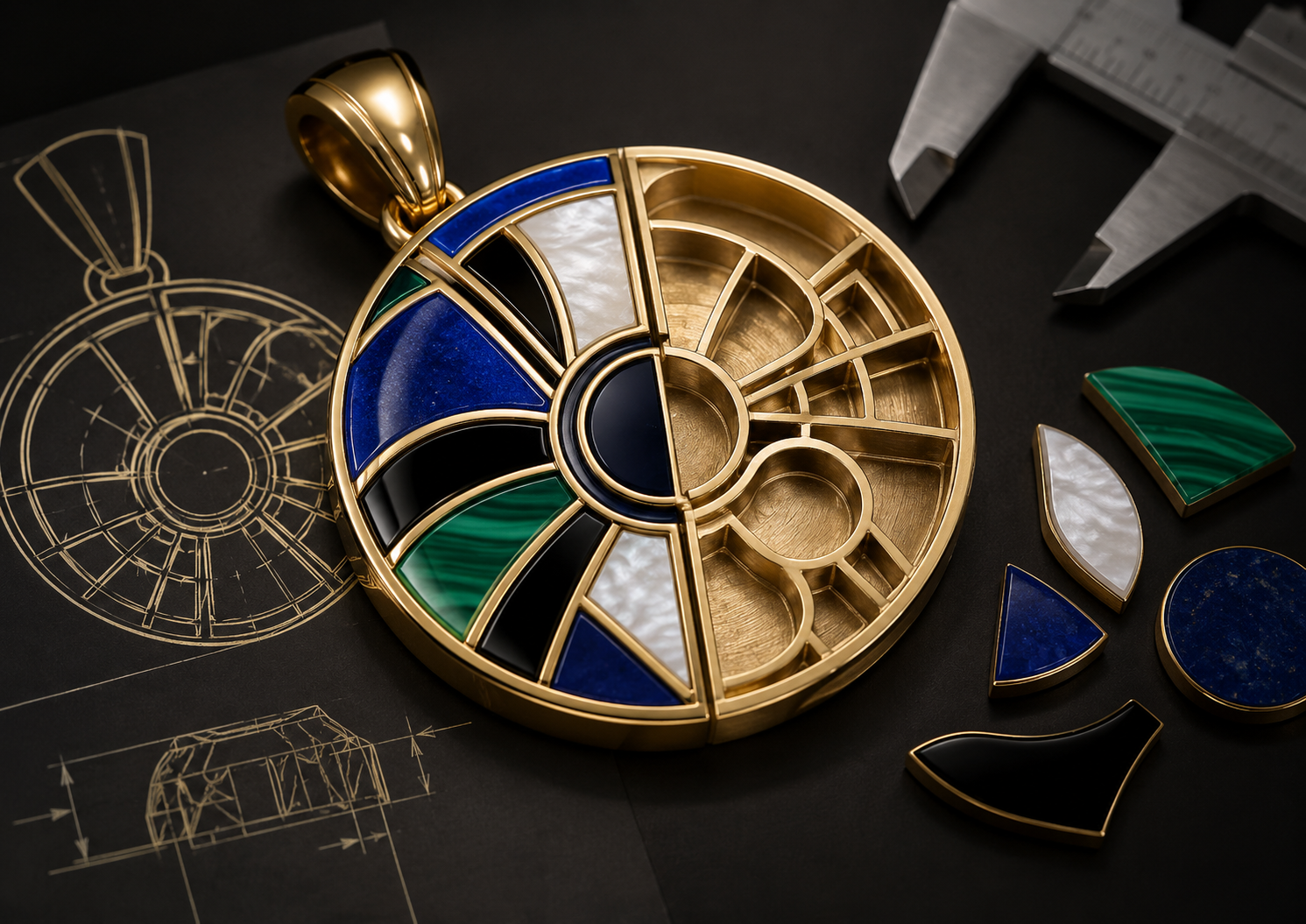
Consider a pendant containing several colored sections. The metal lines separating those colors are not merely outlines. They control the composition, support the enamel, and protect each area during finishing. Their width should remain visually consistent even as the design curves or narrows.
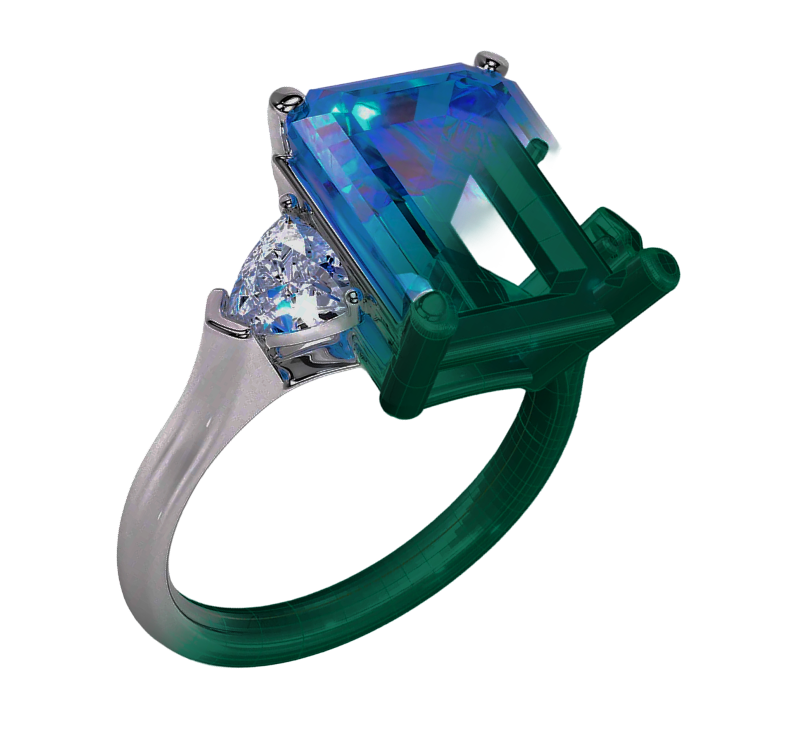
In engagement ring CAD, enamel may appear as a hidden detail inside the gallery, beneath the center setting, or around an engraved message. These locations can create a private element of color, but they may also be difficult to access during application and future repair. The CAD design must allow the enamel to be applied and finished without interfering with the stone setting or weakening the surrounding structure.
The most successful enamel jewelry CAD models treat the metal borders as part of the design language rather than as technical leftovers.
Hardstone, Mother-of-Pearl, and Ceramic Inlays Require Custom Seats
Inlay materials behave differently from enamel because they are usually prepared as separate solid pieces and inserted into the jewelry.
Lapis lazuli, onyx, turquoise, malachite, mother-of-pearl, ceramic, wood, and other materials can all be used for inlay, but they do not share the same strength or manufacturing behavior. Some can be cut precisely but may chip at thin edges. Others are more flexible but sensitive to heat, moisture, chemicals, or impact.
Professional 3D jewelry CAD design must account for the selected material rather than treating every insert as an identical colored object.
A custom seat should support the inlay across an appropriate area. If support exists only along a narrow edge, the insert may become vulnerable to pressure. If the surrounding frame is too heavy, the inlay can lose visual presence. Sharp internal corners may be difficult to match physically, particularly when the insert is cut by hand.
Slightly softened or controlled internal geometry can make production more realistic without changing the intended appearance.
Retention is another important decision. Some inserts are secured with adhesive. Others may be held by a bezel, lip, channel, pin, or mechanical frame. High-value or frequently worn jewelry may benefit from a construction that does not depend entirely on bonding.
The assembly sequence should influence the CAD model. An inlay may need to be inserted after soldering, welding, polishing, or plating because heat and aggressive finishing processes could damage it. The design should provide access at the correct stage without exposing the insert to unnecessary risk.
For a signet ring with an onyx top, the stone seat must control alignment and allow the insert to sit level. For a pendant with mother-of-pearl sections, the metal framework should protect the edges while keeping the piece light. A bracelet with repeated ceramic inserts needs consistent seats so every component follows the same visual rhythm.
Jewelry CAD modeling gives manufacturers a clear technical foundation, but final success still depends on communication with the specialist cutting or fitting the material.
Manufacturing Sequence Determines Whether the Design Is Practical
Enamel and inlay jewelry often require more production stages than a conventional cast-and-polished piece. The order of those stages can determine whether the result remains clean and accurate.
A simplified workflow may involve:
- 3D printing and casting the metal body
- Initial cleanup and surface preparation
- Assembly of separate metal components
- Preliminary polishing
- Stone setting in selected areas
- Enamel application or inlay fitting
- Final finishing and inspection
The actual order varies according to the materials and construction.
Certain enamel processes involve heat, which may influence when gemstones are set or when components are joined. Some stones and adhesives cannot be exposed to high temperatures. Plating may need to occur before or after the colored material is added, depending on whether the process could damage or contaminate the insert.
The CAD model should support the chosen sequence.
If an enamel cell becomes inaccessible after a bail is assembled, the design may require separate finishing or a different connection. If an inlay blocks access to an internal weld, it must be installed later. If polishing around a delicate insert would be risky, the surrounding metal should be finished beforehand.
Production access is often overlooked in jewelry rendering because the final image shows only the completed object. The workshop must understand how the piece reaches that stage.
Casting quality is also important. Rough cavity walls, porosity, incomplete details, or uneven borders can affect enamel and inlay work. The receiving areas may need careful cleanup before the colored material is applied. However, excessive cleanup can alter the dimensions established in the jewelry CAD model.
This makes dimensional control important. The cavity should be inspected after casting and finishing, not assumed to remain identical to the digital geometry.
Jewelry Rendering Must Represent Color and Material Honestly
Colored jewelry is particularly sensitive to visualization. A small change in lighting can make enamel appear brighter, darker, more transparent, or more saturated than it will look in person. Mother-of-pearl may display shifting reflections, while polished onyx can appear almost mirror-like under one environment and softly black under another.
Accurate jewelry rendering should represent the optical behavior of each material rather than applying a simple flat color.
Enamel may be transparent, translucent, or opaque. Light can interact with the polished metal beneath translucent enamel, creating a depth that cannot be reproduced by an ordinary colored surface. Opaque enamel has a more solid appearance but still reflects light differently from metal or resin.
Mother-of-pearl contains directional iridescence. Its appearance changes as the jewelry moves. Ceramic may have a glossy, satin, or matte finish. Hardstone can include veins, bands, or natural variation that should not look like a repeating digital pattern.
Still photography-style rendering is useful for reviewing the overall color balance. It can show whether the metal framework is too dominant, whether neighboring colors compete, and whether the inlay proportions support the design.
Video jewelry rendering is even more valuable for materials whose appearance changes with angle. As the piece rotates, the viewer can see iridescence, transparency, polished reflections, and the changing relationship between the insert and surrounding metal.
However, visualization should not exaggerate the material to make it more dramatic. Enamel should not glow like a light source. Mother-of-pearl should not produce unrealistic rainbow reflections in every direction. Hardstone should retain believable texture and depth.
Jewelry rendering is most useful when it helps designers and clients make informed decisions before manufacturing. It should create confidence without promising an optical effect that the physical material cannot reproduce.
Long-Term Wear, Repair, and Collection Consistency
Colored inserts and enamel surfaces do not age in the same way as solid metal. Their long-term behavior should influence the original design.
Raised enamel near exposed edges may be more vulnerable to impact. An inlay on the outer surface of a ring can experience repeated contact with hard objects. Thin ceramic components may chip if they are insufficiently protected. Adhesives can degrade if the jewelry is exposed to heat, chemicals, or repeated moisture.
The metal structure should protect the colored areas without making them appear enclosed or heavy.
Small raised borders can reduce direct contact. Recessed placement may protect enamel and inlay during wear. Rounded external corners are often safer than exposed sharp points. A replaceable insert can offer long-term serviceability, but only if the design allows removal without destroying the surrounding jewelry.
Repair should not be treated as an unlikely future problem. Fine jewelry may be refinished, resized, restored, or passed to another generation. A design that allows worn enamel to be renewed or an inlay to be replaced has greater long-term value than one that becomes unserviceable after damage.
Collection consistency also requires careful control.
A brand may use the same enamel color, border style, or inlay pattern across rings, earrings, pendants, and bracelets. Yet the details cannot always be copied at identical dimensions. A border suitable for a broad pendant may appear too heavy on a small earring. A ceramic insert that works in a rigid bangle may require additional protection in a ring.
Professional jewelry CAD modeling adapts the material language to the scale and function of each piece.
Photo and video renderings can then present the full collection under consistent lighting, helping the design team judge whether the colors, finishes, and metal boundaries feel related without becoming mechanically repetitive.
Conclusion: Color Must Be Engineered Into the Jewelry
Enamel and inlay can give jewelry a distinctive identity, but their success depends on more than color selection.
The metal structure must support the material. Recesses require controlled depth. Borders need enough strength and visual clarity. Solid inserts need accurately designed seats, realistic tolerances, and a reliable method of retention. Manufacturing order must protect materials from heat, pressure, polishing, and contamination.
3D jewelry CAD design provides the means to plan these relationships before production. Jewelry CAD modeling defines the cavities, supports, interfaces, borders, and assembly logic. Photo and video jewelry rendering allow the materials to be reviewed in context, revealing how color, transparency, texture, and reflection interact with the metal.
For CADVANCE, colored jewelry represents a precise collaboration between digital design and specialist craftsmanship. The CAD model cannot replace the knowledge of the enameller, lapidary, setter, or bench jeweler. It can, however, give each specialist a structure that has been designed with the physical process in mind.
When color is engineered rather than simply applied, enamel and inlay become integral parts of the jewelry. They gain clarity, durability, and a visual presence that remains connected to the construction of the piece itself.