Engineering Movement in Jewelry CAD: Hinges, Clasps, Tolerances, and Multi-Part Construction
Most jewelry is judged while it is still: a ring shown from the top, a pendant suspended against a neutral background, or a bracelet arranged neatly for presentation. Yet many technically demanding pieces only reveal their quality when they move.
Lockets must open and close cleanly. Bracelet links need freedom without feeling loose. Hinged bangles must align after repeated use. Earrings require secure closures that remain comfortable. Box clasps, folding mechanisms, articulated pendants, rotating elements, and concealed joints all depend on controlled movement between separate components.
Designing this type of jewelry requires a different approach from modeling a static object. In 3D jewelry CAD design, movement introduces relationships that cannot be solved by appearance alone. Every part must occupy the correct space, clear neighboring surfaces, survive casting and finishing, and assemble without forcing the workshop to improvise.
A mechanism that works perfectly on screen may become immovable after casting. A joint with generous digital clearance may feel unstable once manufactured. A clasp that looks refined in jewelry rendering may be difficult to polish, assemble, or repair. The success of multi-part jewelry therefore depends on the careful coordination of geometry, tolerances, materials, production methods, and human handling.
For jewelers, manufacturers, designers, and brand owners, articulated jewelry is where jewelry CAD modeling becomes mechanical design on a miniature scale.
Movement Changes the Logic of Jewelry CAD Design
A conventional solid ring can often be evaluated as one continuous object. Its dimensions, setting structure, surface transitions, and comfort can be studied without accounting for separate moving components. Articulated jewelry behaves differently because each part affects the others.
A hinged bangle, for example, is not simply a bracelet divided into two halves. The hinge axis must allow the bangle to open far enough for wear, while the closing edges must return to the correct alignment. The clasp must resist accidental opening, but it should not require excessive force. The hinge knuckles need enough material to remain strong, yet they must not appear disproportionately heavy.
The same principle applies to lockets. The front and back shells must meet cleanly, the hinge should remain visually discreet, and the interior must provide enough space for the intended insert. If the edges are too tight, polishing or plating may prevent closure. If they are too loose, the locket may show an uneven seam.
In articulated pendant CAD modeling, moving parts can create an expressive design, but they also introduce wear points. A rotating symbol, suspended gemstone, or layered element needs controlled freedom. Too little clearance causes friction. Too much clearance produces unwanted movement and visible gaps.
This is why multi-part custom jewelry CAD must begin with function. The appearance of the closed piece is important, but the designer must also study the opening position, movement path, contact surfaces, assembly sequence, and long-term behavior.
Tolerances Are Not Universal Numbers
Tolerance is the intentional space between parts that must fit, move, or assemble. In jewelry manufacturing, there is no single clearance value that works for every mechanism.
The correct tolerance depends on several variables:
- The printing process and its dimensional accuracy
- The castable material used for the pattern
- The metal alloy selected for production
- Casting shrinkage and cleanup
- The amount of polishing required
- Whether the parts will be plated
- The length and diameter of pins
- The size and function of the mechanism
- Whether the movement should feel free, firm, or spring-loaded
A hinge intended for a substantial gold bracelet cannot be treated exactly like a miniature hinge on a delicate locket. A removable pin requires a different fit from a permanently secured pin. A box clasp tongue needs controlled tension, while an articulated link needs freedom of movement without visible looseness.
One of the common mistakes in jewelry CAD modeling is designing parts to meet perfectly with no allowance for the physical process. In CAD software, two surfaces can touch with mathematical precision. In production, however, surfaces are printed, cast, filed, polished, assembled, and sometimes plated. Each stage changes the geometry slightly.
If the original design has no allowance, the finished parts may bind. A hinge hole may become too small after casting. A clasp may lose its intended snap after polishing. A sliding element may seize because the surfaces were designed too tightly.
Excessive clearance creates the opposite problem. Components can rattle, shift, or sit unevenly. The mechanism may function, but it will not feel refined. High-quality jewelry is often distinguished by the quality of its movement: secure without stiffness, smooth without looseness, and precise without appearing mechanical.
Professional 3D jewelry CAD design therefore treats tolerances as a production decision, not a software default.
Designing Hinges, Pins, and Mechanical Interfaces
A successful jewelry hinge depends on more than placing a cylinder through several loops. The hinge must be designed as a complete interface between moving parts.
The knuckles need sufficient wall thickness around the pin hole. Their length and spacing should distribute stress without making the hinge visually dominant. The pin must be long enough to engage the full mechanism, but the ends need an appropriate method of retention. Depending on the construction, the pin may be riveted, laser welded, captured by the surrounding design, or secured through another controlled method.
Alignment is critical. If the hinge axis is even slightly misplaced, the parts may collide during opening. The outer surfaces may align in the closed position but separate awkwardly as the piece moves. In a hinged bangle, an incorrect axis can cause the two halves to open unevenly or place unnecessary stress on the clasp.
Digital testing is useful here. Jewelry CAD modeling allows the designer to rotate components around the intended axis and inspect the full movement path. This can reveal collisions that are invisible in a closed render. It can also show whether decorative elements, gemstones, or internal structures interfere with the mechanism.
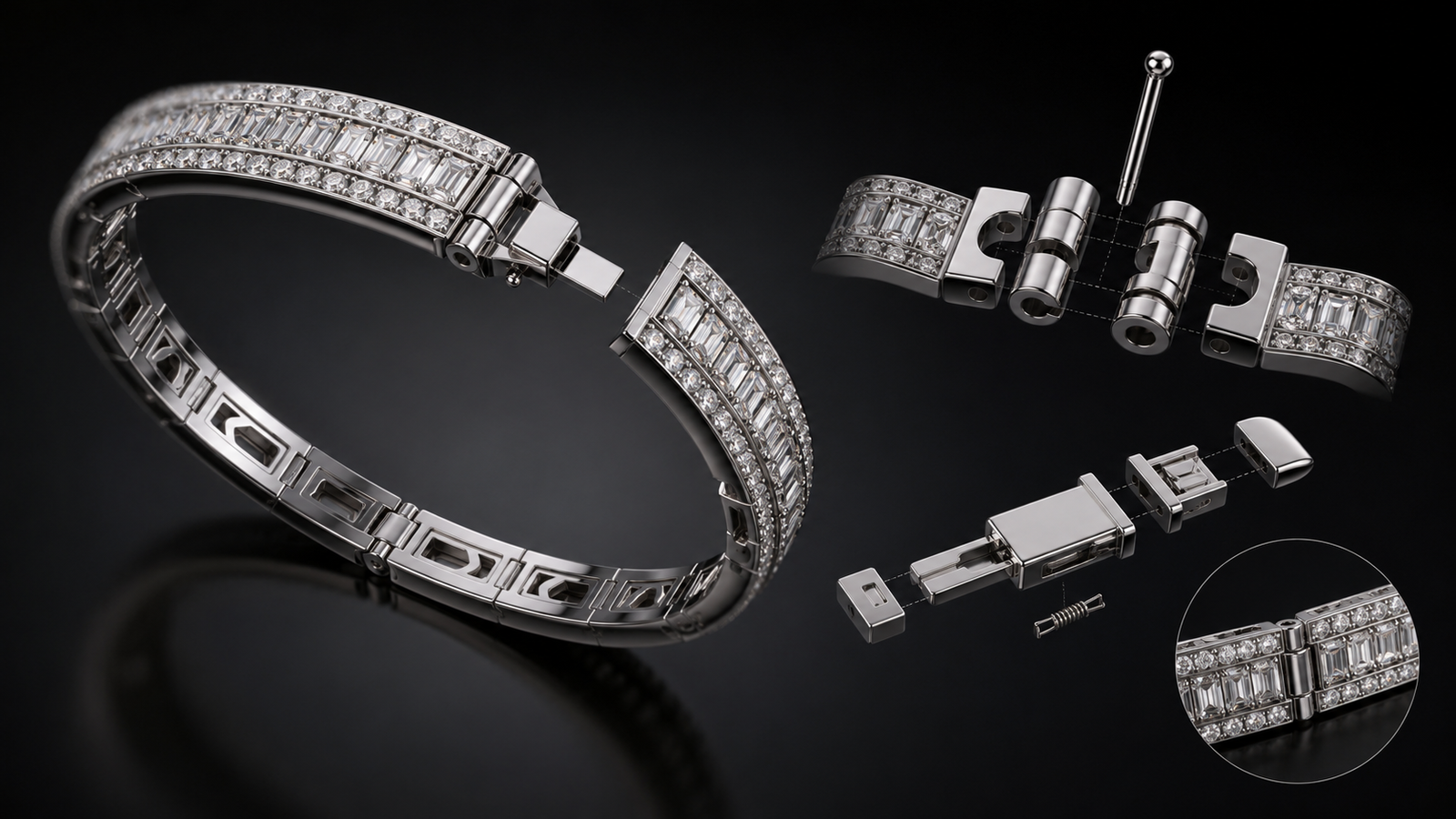
Clasp interfaces require similar care. A box clasp typically involves several interacting features: the receiving box, the tongue, the opening or release area, and often an additional safety element. Each part must be accessible enough for assembly and finishing. The mechanism should remain secure after repeated use, but the surrounding design should protect it from accidental pressure.
In earrings, the closure must also account for the wearer. A hinged hoop needs smooth alignment at the post. A lever-back or similar closure should operate without sharp edges or excessive resistance. The technical solution must remain proportional to the scale of the earring and comfortable near the ear.
These details are rarely the visual focus of a piece, but they often determine whether the jewelry feels expertly made.
Assembly Must Be Planned Before Production
Multi-part jewelry cannot be designed intelligently without considering how it will be assembled.
A CAD model may contain several beautifully formed components, but if the assembly order is unclear, production becomes unnecessarily difficult. The workshop may discover that a pin cannot be inserted after stones are set, that a hidden surface cannot be polished once parts are joined, or that a component blocks access to a soldering or laser-welding area.
The assembly sequence should therefore influence the CAD structure from the beginning.
For a hinged diamond bangle, the manufacturer may need to cast the main halves separately, clean and polish internal surfaces, prepare the hinge, test alignment, set stones, and complete final assembly in a carefully controlled order. If the design does not provide access for these steps, the bench jeweler may be forced to modify the model or accept a lower-quality finish.
Articulated jewelry with multiple links creates additional challenges. Each link must be manufacturable, repeatable, and easy enough to assemble without damaging the surface. If the link design includes gemstones, the timing of stone setting becomes important. Some elements may need to be assembled before setting; others may be safer to set first.
Production-ready jewelry CAD should also consider where sprues may be placed, how components will be supported during 3D printing for jewelry, and which surfaces will require cleanup. A visually perfect exterior is not enough if the inner hinge area contains rough, inaccessible geometry.
Digital jewelry manufacturing works best when design and assembly are treated as one process. The CAD file should communicate not only what the finished piece looks like, but how it can realistically become that object.
Finishing Can Change the Behavior of a Mechanism
Polishing is sometimes treated as a purely cosmetic stage, but in moving jewelry it can affect function.
Polishing removes material. On decorative surfaces, that may soften edges or refine transitions. On a hinge, clasp, pin, or sliding interface, even a small change can affect the fit. A clasp tongue may lose tension if it is over-polished. A pin hole may become enlarged. Matching edges may no longer meet evenly. Fine mechanical details may become rounded and less precise.
Plating adds another variable. A plated surface gains a thin additional layer, which may matter when two components are already designed with minimal clearance. Although the change is small, miniature mechanisms can be sensitive to small dimensional differences.
The CAD designer must therefore anticipate finishing rather than assuming the cast object will remain dimensionally unchanged. Contact surfaces may need different treatment from visible surfaces. Some areas should be protected from excessive polishing, while others require enough access to be finished properly.
Stone setting can also influence movement. In an articulated diamond bracelet, setting pressure may subtly distort small components if their structure is too light. Decorative pavé near a hinge can restrict access or weaken the area surrounding the mechanism. Stones placed too close to a clasp may make future repair difficult.
Unlike engagement ring CAD, where the primary technical focus often centers on the stone setting, gallery, and shank, articulated jewelry requires simultaneous control of stone placement and mechanical behavior. Neither can be designed in isolation.
Prototyping Reveals What Static Rendering Cannot
Jewelry rendering is valuable for reviewing proportions, surfaces, metal colors, gemstone appearance, and presentation. It can show a clasp in both open and closed positions or illustrate how articulated elements relate visually. However, rendering cannot fully communicate how a mechanism feels.
Movement has tactile qualities. A hinge may be technically free but feel rough. A clasp may close securely but require uncomfortable force. A bracelet may articulate smoothly in one direction while twisting unexpectedly in another. These issues often become clear only through physical prototyping.
For complex mechanisms, a test print or non-precious prototype can provide valuable information before final production. It allows the designer and manufacturer to study the movement path, assembly logic, clearances, alignment, and overall handling. The prototype does not perfectly reproduce the behavior of cast metal, but it can identify major geometric problems early.
Digital simulation and physical testing should support each other. CAD is excellent for controlling dimensions and visualizing movement. Prototyping introduces gravity, friction, handling, and assembly realities.
This combination is particularly important for new mechanisms, unconventional clasps, modular jewelry, transformable pieces, and articulated designs that have no established production history. A manufacturer may already understand a familiar hinge construction, but a custom moving concept deserves more careful validation.
The goal is not simply to prove that the parts can move. It is to ensure that the movement feels appropriate for fine jewelry.
The Quality of Movement Is Part of the Luxury Experience
A piece of jewelry communicates quality before the wearer studies its technical construction. The clasp closes with certainty. The hinge moves smoothly. The links follow the wrist naturally. The locket opens without resistance and closes with clean alignment. These interactions create trust in the object.
Poor movement has the opposite effect. Rattling components, uneven seams, weak closures, excessive stiffness, and visible misalignment can make even an expensive piece feel unfinished.
This is why articulated jewelry requires close cooperation between design and manufacturing. The CAD designer must understand production limitations, and the workshop must understand the intended movement. A mechanism cannot be judged only by whether it works once. It must also be considered in relation to repeated use, wear, servicing, and repair.
Components that experience friction may change over time. Pins can wear. Clasp tension can weaken. Joint surfaces can loosen. The design should allow for realistic maintenance where possible. A permanently enclosed mechanism may look clean, but if it cannot be serviced without damaging the piece, its long-term value may be compromised.
The most successful custom jewelry CAD balances elegance, mechanical clarity, and future care. The mechanism should support the design rather than compete with it.
Conclusion: Precision Becomes Visible Through Movement
Articulated jewelry exposes the quality of its engineering every time it is handled. Hinges, clasps, links, pins, and moving settings may occupy only a small part of the visual design, but they define how the piece functions in real life.
Professional 3D jewelry CAD design allows these mechanisms to be developed with controlled geometry, realistic clearances, planned assembly, and careful consideration of casting and finishing. Yet software alone cannot guarantee success. Reliable movement depends on technical judgment, manufacturing experience, physical testing, and an understanding of how jewelry changes through wear.
For CADVANCE, the engineering of movement represents an important part of contemporary digital craftsmanship. A refined mechanism should not draw attention to its complexity. It should feel natural, secure, and inevitable.
When a bangle opens smoothly, a clasp closes precisely, or an articulated pendant moves with controlled freedom, the technical work becomes part of the luxury experience. That is the long-term value of thoughtful jewelry CAD modeling: not only creating an object that looks correct, but designing one that behaves with equal precision.