Engineering Two-Tone Jewelry in CAD: Metal Separation, Assembly, and Manufacturing Precision
Two-tone jewelry is often admired for its visual contrast. White and yellow gold can define separate architectural elements, rose gold can soften a diamond setting, and platinum details can create a refined transition against warmer alloys. When designed well, the contrast appears effortless. In production, however, two-tone jewelry is rarely simple.
A piece made from more than one metal must be divided, assembled, finished, and inspected with much greater control than a single-metal design. The visual boundary between materials may also be a structural joint. A decorative inlay may need to survive polishing without losing its proportions. Separate cast components must align accurately before soldering or laser welding. Plated areas require clean masking and realistic expectations about wear.
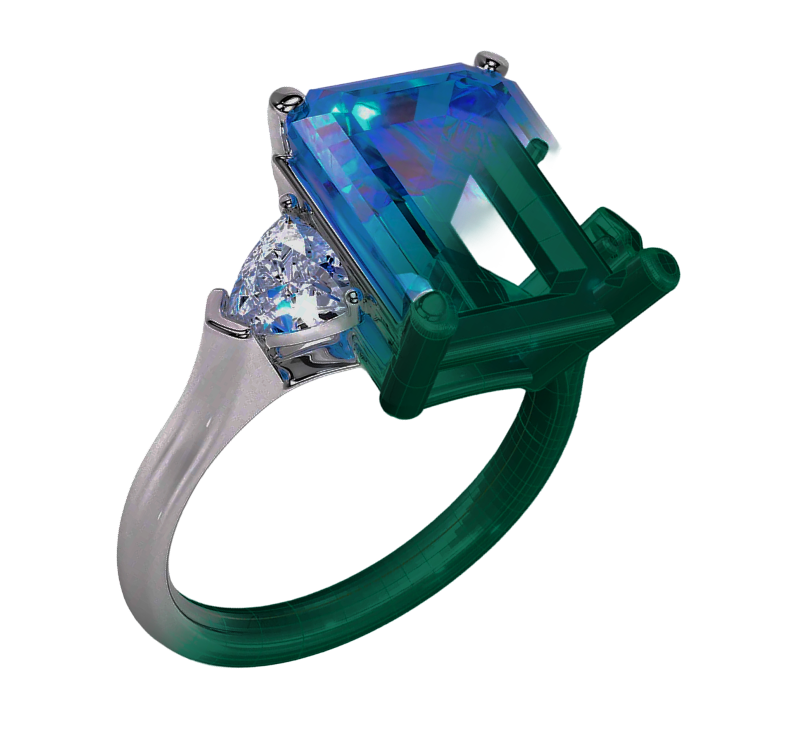
Professional 3D jewelry CAD design makes these relationships visible before manufacturing begins. It allows the designer to determine where metals should meet, how components will be assembled, which surfaces require access, and whether the intended contrast can be reproduced consistently in finished jewelry.
Jewelry rendering also plays an important role. Accurate photo and video renderings can show whether the material contrast supports the design or makes it feel fragmented. Yet visualization is useful only when it reflects a realistic manufacturing strategy.
Two-tone jewelry is therefore not simply a color decision. It is a coordinated exercise in jewelry CAD modeling, material behavior, assembly planning, finishing, and long-term maintenance.
Two-Tone Design Begins With a Clear Material Architecture
The strongest two-tone jewelry has a clear reason for using more than one metal. The secondary material may define a border, highlight a center setting, separate a monogram from its background, or create contrast between sculptural layers. When the material arrangement follows the structure of the piece, the result feels intentional.
Problems arise when metal changes are applied without considering how the jewelry will be built.
A digital model can assign different colors to any surface instantly. Manufacturing cannot. Each visible material zone must correspond to a practical production method. The design may require separate cast parts, an inserted component, a welded assembly, a mechanically secured element, selective plating, or a combination of processes.
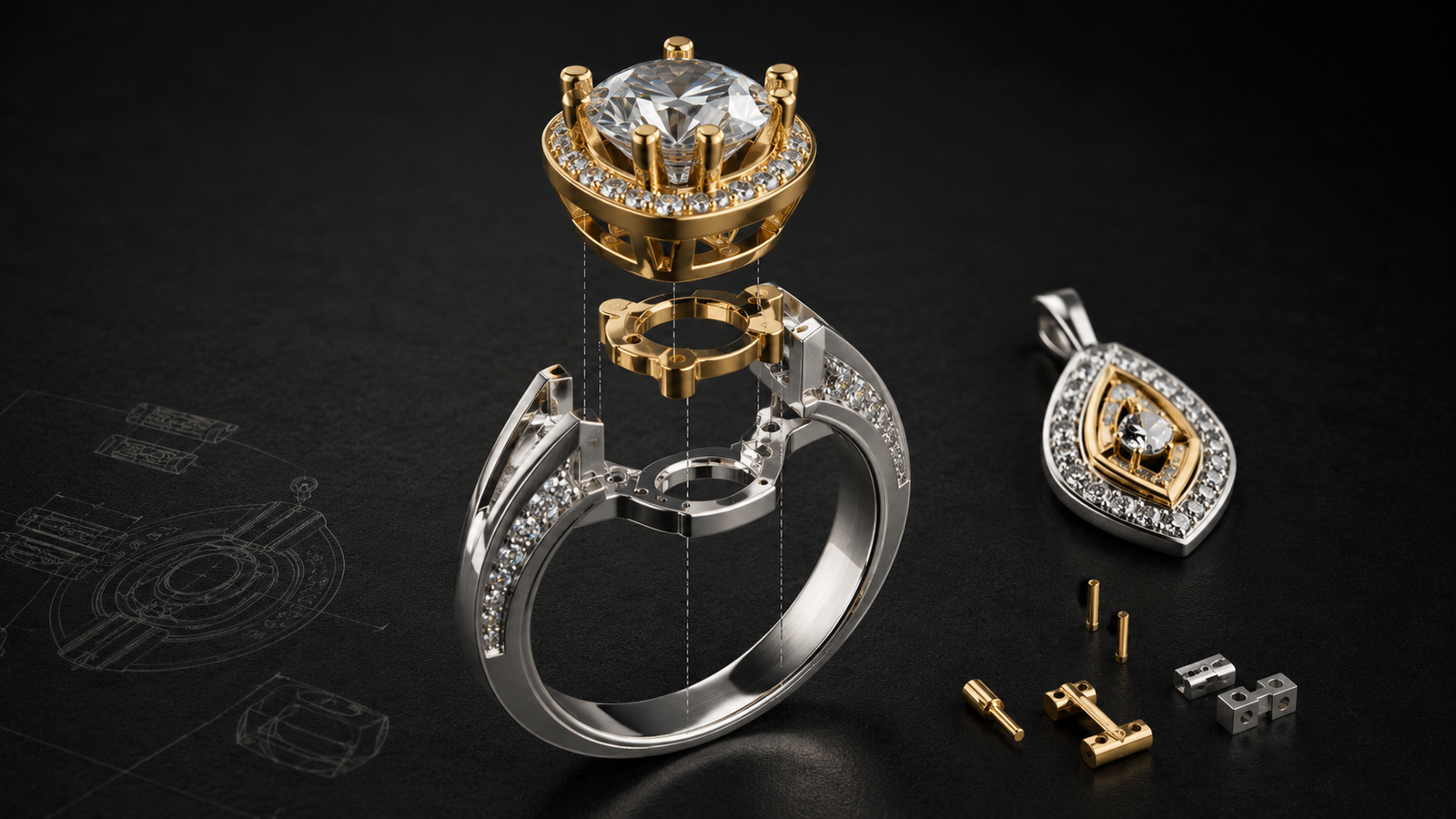
For example, a white gold engagement ring with a yellow gold center setting may be divided into two principal components: the shank and the head. This separation is relatively logical because the setting already functions as a distinct structural element. A pendant with alternating gold colors across an intricate pattern is more complicated. If every small color area requires a separate component, assembly may become inefficient or impossible.
The material architecture should therefore be established early in the 3D jewelry CAD design process.
Useful questions include:
- Which elements genuinely need to be separate metals?
- Can the parts be cast and finished independently?
- Where will the joints be positioned?
- Will the assembly remain accessible after stone setting?
- Can the color boundary stay clean during polishing?
- Is plating more practical than solid multi-metal construction?
- Will the chosen method remain durable during wear and repair?
The answers influence the geometry of the entire piece.
A successful two-tone design is not merely divided visually. It is divided intelligently.
Component Separation Must Support Accurate Assembly
When two-tone jewelry is made from separate metal components, the CAD model must include a clear method of alignment.
Two parts that appear to meet perfectly on screen may be difficult to position during assembly. Smooth surfaces can slide. Curved components may rotate slightly. A decorative insert can sit too deep on one side and too high on the other. Small alignment errors become especially visible when contrasting metals meet along a polished border.
Professional jewelry CAD modeling can introduce controlled locating features. These may include shallow seats, tabs, pins, recessed channels, matching profiles, or interlocking surfaces. Their purpose is not always to provide final strength. Often, they help the bench jeweler position the parts correctly before soldering or laser welding.
The fit should be secure enough to maintain alignment but not so tight that casting variation prevents assembly. This requires practical tolerance.
A yellow gold emblem inserted into a white gold pendant, for instance, may sit inside a recessed pocket. The pocket defines its position and controls the visible border. If the fit is mathematically exact, the insert may not seat properly after casting and cleanup. If the clearance is excessive, the border may look uneven or require significant filling during assembly.
The CAD designer must also consider how the parts will be held while joining. A beautiful internal connection may be useless if tools cannot reach the seam or if the components cannot be stabilized.
Assembly order matters as well. Some parts should be joined before final polishing. Others may need individual finishing first because the surfaces become inaccessible after assembly. Gemstones may need to be set before or after joining, depending on heat sensitivity, tool access, and the method used to connect the metals.
Two-tone custom jewelry CAD is therefore closely linked to bench procedure. The geometry should make the intended assembly understandable rather than leaving the workshop to invent a solution after casting.
Soldering, Laser Welding, and Mechanical Connections Require Different CAD Decisions
There is no universal joining method for multi-metal jewelry. The appropriate technique depends on the alloys, component size, joint location, gemstone presence, finishing requirements, and workshop capabilities.
Traditional soldering remains widely used. It can create strong joints, but heat affects the surrounding metal and may influence previously completed work. Solder color, flow, cleanup, and the possibility of visible seams must be considered. The joint should provide enough contact area for reliable bonding without creating excess material that is difficult to remove.
Laser welding offers greater control in many two-tone assemblies. It can concentrate heat in a smaller area and is useful near detailed components or previously finished sections. However, laser welding does not remove the need for good joint design. Poorly aligned surfaces, large gaps, or inaccessible seams still create problems.
Mechanical connections offer another option. An element may be riveted, threaded, captured, folded, or secured through interlocking geometry. These solutions can be useful when heat should be avoided or when components may need future replacement. They also introduce their own requirements for tolerances, wear, and assembly.
The 3D jewelry CAD design should reflect the chosen method.
A broad soldered seam may require more contact area. A laser-welded joint may benefit from a narrow, controlled interface. A mechanical connection needs enough material around pins, screws, or locking features. A decorative insert held by surrounding metal must remain secure after polishing and long-term wear.
The choice also affects future repair. A permanently welded component may be visually clean but difficult to replace. A mechanically secured element may be serviceable but require more space.
For high-end jewelry manufacturing, the best solution is not always the most technically elaborate. It is the one that supports accuracy, durability, finishing quality, and realistic workshop practice.
Finishing Two Metals Without Losing the Boundary
Polishing is one of the most sensitive stages in two-tone jewelry production. Different alloys may respond differently to abrasives, pressure, heat, and polishing compounds. Even when the components have been assembled accurately, finishing can change the visible relationship between them.
A crisp boundary may become rounded. One material may be polished slightly lower than the other. Fine solder residue can remain visible. A narrow inlay may lose width. Brushed or matte areas may become contaminated by nearby high-polish work.
The CAD geometry should help preserve the material separation.
A small height difference can define a border. A recessed inlay can protect its edges. A polished frame can surround a textured center. Distinct bevels can create a controlled transition between metals. These features make finishing easier because they provide a physical boundary rather than relying only on surface color.
However, transitions should not become unnecessarily complicated. Very narrow channels may be difficult to polish. Deep recesses can trap compound. Sharp internal corners may remain unfinished. Highly intricate two-tone patterns can require excessive hand labor that was not obvious in the digital model.
Surface finish should also be considered alongside metal color.
Yellow gold with high polish may create strong contrast against brushed white gold. Rose gold can appear more distinct when surrounded by a frosted surface. Two polished metals may reflect the same environment so strongly that the intended color difference becomes less visible.
Jewelry rendering can help evaluate these effects, but the materials must be represented accurately. White gold should not be shown as neutral white paint, and platinum should not be treated as simply a brighter version of silver. The visual differences are subtle and depend on lighting, roughness, and surrounding reflections.
A technically honest render helps determine whether the design needs a stronger physical boundary or a different surface treatment before production begins.
Solid Multi-Metal Construction and Selective Plating Are Not Equivalent
Some two-tone effects are created with separate solid metals. Others are achieved through plating. The two methods may appear similar in a product image, but they differ significantly in construction, durability, cost, and maintenance.
Solid multi-metal jewelry contains physically distinct alloys. The contrast can survive normal refinishing because the color is not limited to the surface. The piece may be more complex to manufacture, but the material identity remains present throughout the component.
Selective plating applies a thin layer of metal to chosen areas. It can create detailed color contrast without requiring numerous separate parts. It is often suitable for recessed backgrounds, decorative zones, or surfaces that are difficult to construct as solid inserts.
However, plating is a surface treatment. Areas exposed to friction, repeated contact, or aggressive polishing may wear over time. Sharp boundaries may require careful masking. Recessed zones may retain plating better than raised edges or broad contact surfaces.
These differences should influence both custom jewelry CAD and client expectations.
A design that depends on a rose gold edge around the exterior of a frequently worn ring may not behave the same when plated as it would in solid rose gold. A black rhodium background inside a recessed engraving can be more practical because the treated area is protected. A yellow gold accent inside a pendant may be achieved through either a solid insert or selective plating, but the visual result, manufacturing cost, and long-term service will differ.
Jewelry photo and video renderings should not blur that distinction. A plated finish should be presented as a surface treatment rather than making it appear structurally identical to a solid-metal component.
Material accuracy is part of responsible visualization.
Two-Tone Jewelry Rendering Requires Controlled Lighting
Two-tone jewelry can be difficult to render because metal color is strongly influenced by its environment. Reflective surfaces do not display color in isolation; they mirror surrounding lights, objects, and backgrounds.
Under poor lighting, yellow and rose gold may appear too similar. White gold and platinum may become visually indistinguishable. Dark environments can make polished metal look black, while excessively warm lighting can distort every alloy toward yellow.
Professional jewelry rendering requires a lighting setup that reveals material differences without exaggerating them.
Still images should show the major color boundaries clearly. Close-up views can demonstrate inlays, borders, mixed finishes, and joint transitions. Side and rear views are especially useful when the material separation continues around the piece rather than existing only on the front.
Video rendering adds important information because reflections move across the surfaces as the jewelry rotates. The viewer can see whether a secondary metal remains visually distinct from several angles. Motion may also reveal a boundary that disappears in one still image.
For engagement ring CAD, animation can show how a yellow gold basket relates to a white gold shank from the front, side, and rear. For a pendant, it can reveal whether the two-tone arrangement continues through the bail and back structure. For bracelets and articulated pieces, it can show whether the color sequence remains consistent during movement.
The render should be based on the same component structure intended for manufacturing. If a line exists only as a color change in the image but has no practical production method, the visualization creates an expectation that may not be achievable.
In high-end digital jewelry manufacturing, rendering should verify the material architecture rather than invent it.
Long-Term Wear and Repair Should Influence the Original Design
Two-tone jewelry continues to change after it leaves the workshop. Polished surfaces accumulate scratches. Plating can wear. Joints experience stress. Rings may require resizing. Pendants may need bail repair. Clasps and hinges may eventually need servicing.
These possibilities should influence the original jewelry CAD model.
A two-tone ring can be more difficult to resize when the material boundary passes through the lower shank. A decorative insert near an exposed edge may be vulnerable to impact. A plated section may need future restoration. A welded emblem may complicate refinishing if the surrounding metal must be polished repeatedly.
The best material layout supports both visual quality and future maintenance.
Where possible, resizeable areas should remain structurally simple. Replaceable elements should be accessible. Plated zones should be positioned where wear is predictable and manageable. Contrasting components should have enough thickness to survive refinishing.
For jewelry brands, this long-term view protects consistency. A design may look impressive in the first campaign rendering, but its real quality is proven through years of wear, repair, and service.
Luxury jewelry should not be engineered only for its first presentation. It should be designed for continued ownership.
Conclusion: Two-Tone Jewelry Is a Structural Discipline
Two-tone jewelry succeeds when its material contrast is supported by clear construction. Color alone is not enough.
Professional 3D jewelry CAD design determines where metals meet, how components align, which joining method is appropriate, and how the piece can be finished without losing its boundaries. Jewelry CAD modeling also helps establish realistic tolerances, assembly order, serviceability, and production documentation.
Photo and video jewelry rendering then provide a visual test. They show whether the contrast remains clear, whether surface finishes support the materials, and whether the design stays coherent from every angle. But the visualization must remain connected to a practical manufacturing strategy.
For CADVANCE, multi-metal design represents the point where visual restraint and technical planning become inseparable. The most refined two-tone pieces do not look assembled from unrelated parts. Their materials appear to belong together because every boundary, joint, surface, and proportion has been considered as part of one complete object.
When metal separation is planned with precision, two-tone jewelry gains more than contrast. It gains structure, identity, durability, and a manufacturing logic capable of preserving the design throughout its full working life.