From Bespoke to Scalable: How Parametric Jewelry CAD Supports Made-to-Order Collections
Personalization has become one of the strongest forces shaping contemporary jewelry. Clients no longer expect only a choice between yellow gold and white gold. They increasingly want control over center-stone shape, gemstone color, engraving, ring width, setting style, chain length, surface finish, and other details that make a piece feel personal.
For jewelry brands, this demand creates both an opportunity and a technical challenge.
A custom ring may be straightforward when it is developed as a single project. The difficulty begins when a brand wants to offer dozens or hundreds of controlled variations while maintaining consistent design quality, manufacturing reliability, and visual presentation. Every variation must still look intentional. Every stone must fit. Every model must remain suitable for 3D printing, casting, setting, polishing, and final inspection.
This is where parametric 3D jewelry CAD design becomes valuable.
Instead of treating each variation as an unrelated model, a structured jewelry CAD modeling system can define which parts of a design may change and which must remain protected. Dimensions, stone sizes, prong positions, shank widths, setting heights, and decorative elements can be connected through controlled rules. The result is a flexible design family rather than a collection of disconnected files.
When combined with accurate jewelry rendering and disciplined manufacturing review, parametric CAD gives brands a practical way to offer personalization without turning every order into a complete redesign.
Personalization Creates Hidden Production Complexity
From the customer’s point of view, changing a gemstone or selecting a different ring width may appear simple. From a manufacturing perspective, even a small variation can affect the entire structure of a piece.
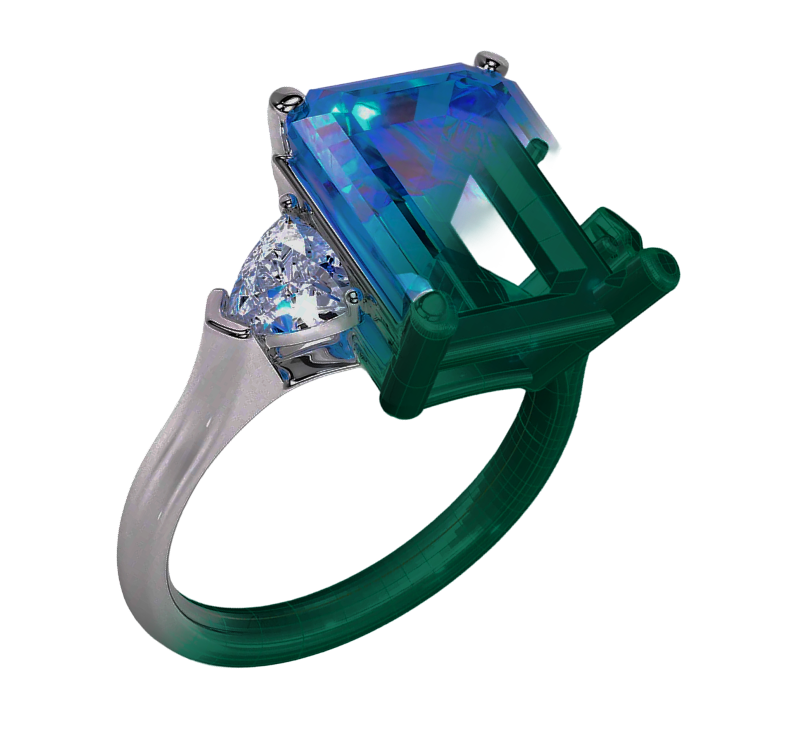
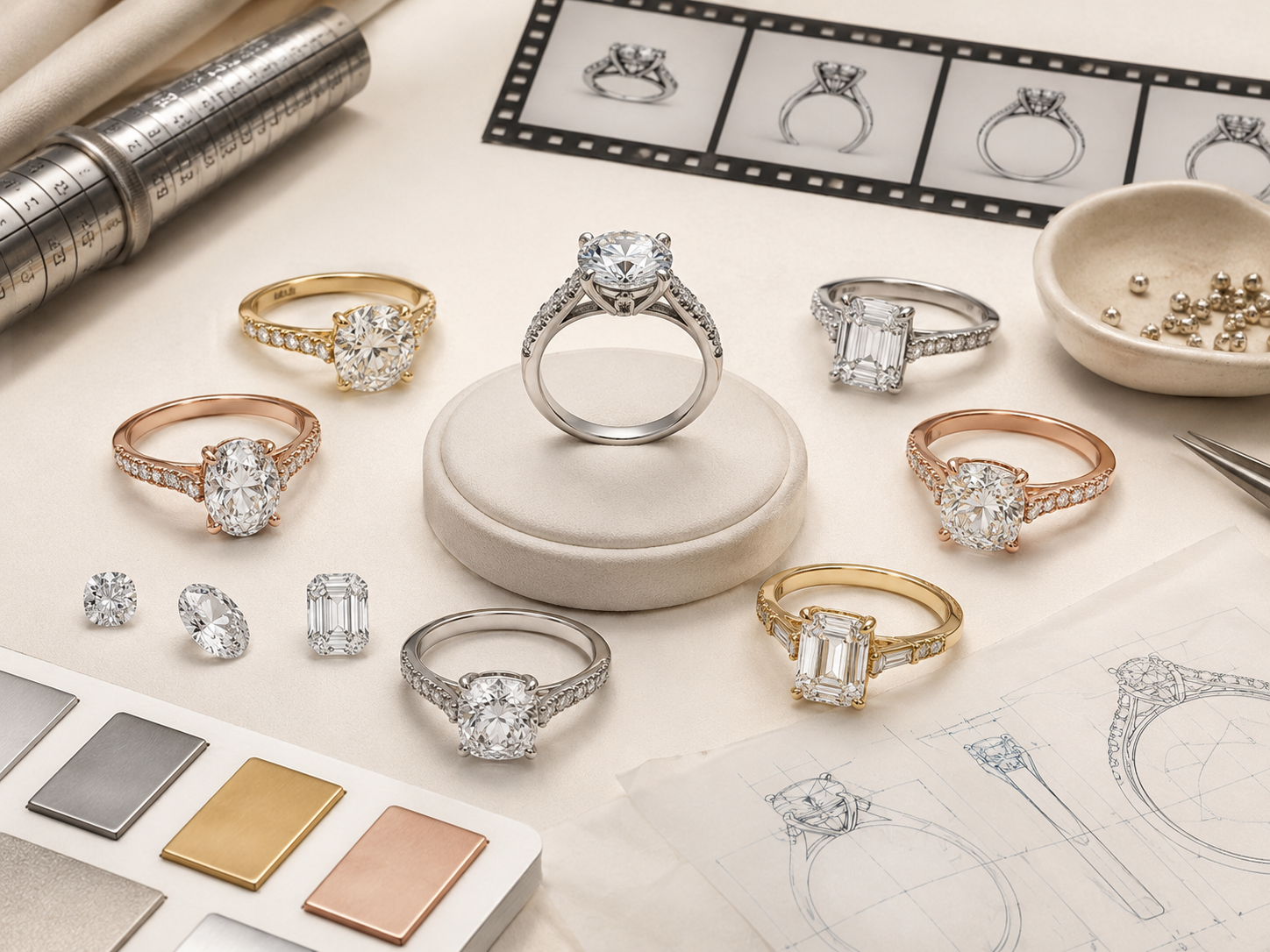
Consider an engagement ring available with round, oval, cushion, and emerald-cut center stones. Each shape requires a different setting architecture. Prong positions change. The gallery may need to be wider or taller. The wedding-band fit may be affected. Side stones may need to move, and the overall visual balance of the ring may shift.
The same problem appears when one design is offered across a wide range of center-stone sizes. A setting created for a one-carat round diamond cannot always be enlarged proportionally for a three-carat stone. The prongs, basket, shank, shoulders, and support structure need to be reconsidered. Uniform scaling can make the ring too heavy, too high, or structurally weak in the wrong areas.
Metal choice adds another layer. A design offered in several alloys may require different production decisions. A delicate structure suitable for one material may need adjustment in another. Stone-setting access, casting behavior, polishing allowance, and finished weight may all change.
Personalization therefore creates a network of technical dependencies. One customer-facing choice can influence several hidden manufacturing conditions.
Professional custom jewelry CAD must account for these relationships rather than treating each option as a cosmetic change.
Parametric CAD Builds a Controlled Design System
Parametric jewelry CAD is based on relationships between dimensions and components. Instead of editing every part manually, the designer defines how elements should respond when a controlled value changes.
A ring model, for example, may include linked parameters for:
- Finger size
- Shank width and thickness
- Center-stone dimensions
- Setting height
- Halo spacing
- Shoulder angle
- Side-stone count
- Prong diameter
- Gallery clearance
- Wedding-band compatibility
These relationships allow the design to adapt while preserving its intended proportions.
The purpose is not to automate creativity. It is to protect the approved design language while reducing repetitive remodeling. A brand may have a distinctive setting profile, shoulder shape, or gallery detail that should remain recognizable across several products. Parametric jewelry CAD modeling makes it possible to retain those features while adjusting the technical structure for different stones or sizes.
This approach is especially effective for product families. A central design may become a solitaire ring, halo ring, three-stone ring, matching wedding band, pendant, and pair of earrings. Each piece still requires category-specific engineering, but shared design elements can be developed from a controlled digital system.
The quality of the system depends on the quality of its rules. Poorly constructed parameters can create distorted geometry, weak intersections, impractical stone layouts, or files that appear correct only in limited configurations. Every controlled variation must therefore be tested at its smallest, largest, and most demanding conditions.
A parametric model is valuable only when it produces reliable jewelry.
Stone and Setting Variations Need Defined Boundaries
Gemstones are one of the most difficult parts of configurable jewelry design because they are not simple interchangeable objects.
Two oval stones with the same length and width may have different depths, girdle shapes, crown heights, and pavilion angles. Natural gemstones can also contain irregularities that affect how they should be supported and set. A configuration system must therefore distinguish between visual options and production-confirmed options.
For calibrated stones, a brand may define a controlled range of approved dimensions. The engagement ring CAD can then adjust the seat, prongs, halo, and gallery within those boundaries. For non-standard stones, the selected configuration may still require manual review and a custom setting.
This distinction protects both the design and the gemstone.
The same principle applies to pavé and accent stones. If a band becomes wider or a ring size changes, the stone count may no longer remain the same. Forcing an existing layout into a different circumference can produce inconsistent gaps or awkward spacing. A better system recalculates the layout or provides approved stone-count groups for different size ranges.
Prongs and bezels also need limits. A prong should not become excessively thin simply because the center stone is reduced. A bezel should not become visually heavy when adapted to a small gem. The system must include minimum and maximum conditions based on real stone setting and manufacturing requirements.
Parametric jewelry design is strongest when it knows when to stop. Some variations can be generated reliably. Others should be returned to the designer for individual judgment.
Jewelry Rendering Makes Configuration Understandable
A configurable CAD system is useful internally, but customers and sales teams still need a clear way to understand the available choices. Technical model names and dimensional tables do not communicate how a final piece will feel.
Photorealistic jewelry rendering can translate each approved configuration into a realistic visual.
A client may compare:
- Round and oval center stones
- Yellow, white, and rose gold
- Diamond and colored gemstone options
- High-polish and matte finishes
- Different shank widths
- Solitaire and halo settings
- Plain and pavé-set bands
Still images are useful for direct comparison. When camera position, scale, and lighting remain consistent, differences between configurations become easier to evaluate. A customer can see how rose gold changes the warmth of the piece or how an oval center stone alters the ring’s overall proportion.
Video rendering adds another level of clarity. A controlled rotation can reveal side height, gallery design, stone projection, and the relationship between the ring and matching band. For pendants or earrings, video helps communicate thickness, movement, and volume.
The render must be linked to the actual configuration. A visual system loses credibility if the image shows a delicate setting while the manufacturing file requires heavier prongs or a deeper gallery. The photorealistic output should reflect the same geometry that will be reviewed for production.
For made-to-order jewelry, rendering is not merely decoration. It is part of the configuration process. It helps buyers choose with greater confidence and gives the production team a visual reference for the approved variation.
Manufacturing Rules Must Be Built Into the Workflow
A configurable product should not move directly from customer selection to manufacturing without technical validation.
Even when a model is generated from a tested parametric system, each order should pass through defined checks. These may include stone dimensions, wall thickness, prong size, ring size, metal weight, assembly clearance, setting access, and STL integrity.
The workflow may classify configurations in different ways.
Some combinations can be approved automatically because they fall within fully tested ranges. Others may require a designer’s review. Certain unusual gemstone dimensions or extreme ring sizes may require a custom rebuild rather than a generated variation.
This approach avoids two common mistakes.
The first is excessive manual work, where every order is treated as a new project even when most changes are predictable. The second is excessive automation, where files are generated without enough attention to real manufacturing conditions.
A controlled system sits between those extremes.
For example, a ring may be available from size 5 to size 9 through an approved model family. Sizes outside that range may require individual adjustment to the shank, stone layout, or overall proportion. A pendant may support three standard chain widths, while larger chains require a custom bail. A halo design may be configurable for a specific group of calibrated center stones but not for irregular heirloom gems.
These boundaries should be established during jewelry CAD development, not discovered after an order reaches production.
Manufacturing consistency comes from combining automation with expert review.
Scaling Personalization Without Losing Craftsmanship
There is a risk that configurable jewelry can become visually generic. When too many options are generated from a simple template, the products may feel assembled rather than designed.
High-end customization requires more than replacing stones and changing metal colors. The proportions must remain refined in every approved variation. Decorative elements must respond intelligently. The piece should still look as though it was designed around the selected gemstone and not adapted afterward.
This is where human judgment remains essential.
A parametric system can manage dimensions, relationships, repeated features, and approved variants. It cannot always judge whether a particular configuration has elegance, restraint, or character. Those qualities require visual assessment.
A three-carat oval ring may need stronger shoulders than its one-carat version, but simply increasing every dimension can make it look heavy. A pendant offered with several gemstones may need different border proportions for each color and cut. A bracelet adjusted for a larger wrist may need additional links rather than stretched components.
The best configurable systems support craftsmanship rather than replacing it. They reduce repetitive technical work so that designers can concentrate on proportion, refinement, and difficult exceptions.
For jewelry brands, this creates a more sustainable form of personalization. Customers receive meaningful choice, while the design remains controlled and the workshop receives files that have been developed with production in mind.
Conclusion: Personalization Needs Structure
Made-to-order jewelry is often presented as a question of choice. In reality, it is a question of systems.
Every additional gemstone, metal, size, finish, or setting option creates new design and manufacturing relationships. Without structure, customization becomes slow, inconsistent, and difficult to scale. With a disciplined parametric workflow, those relationships can be managed more intelligently.
Professional 3D jewelry CAD design provides the technical foundation. Jewelry CAD modeling defines how forms respond to approved changes. Photorealistic jewelry rendering makes the options understandable. Manufacturing rules protect the transition from digital configuration to physical production.
For CADVANCE, parametric design represents a practical extension of high-level digital craftsmanship. It allows repeated decisions to be controlled without reducing jewelry to a generic template. It creates flexibility while preserving proportion, structure, and production quality.
The long-term value lies in balance. Automation should handle predictable variation. Designers should remain responsible for judgment. Manufacturers should receive validated files rather than unchecked outputs.
When those roles are clearly defined, made-to-order jewelry can remain personal without becoming inconsistent, and scalable without losing the precision expected from fine jewelry.