Rebuilding Existing Jewelry in CAD: From Worn Heirlooms to Accurate Digital Models
Not every jewelry project begins with a clean sketch, a new collection brief, or a blank screen. Many of the most technically demanding projects begin with something far less perfect: a worn ring, a broken pendant, a single remaining earring, an old family piece, a damaged setting, or a client’s request to recreate a design that no longer exists in usable condition.
This side of 3D jewelry CAD design is often underestimated. Rebuilding existing jewelry requires a different kind of discipline than creating a new design from imagination. The goal is not only to make something beautiful. The goal is to understand what already exists, identify what must be preserved, correct what no longer works, and translate the piece into an accurate digital model that can be manufactured again.
For jewelers, manufacturers, and brand owners, this work sits between restoration, redesign, reverse engineering, and digital jewelry manufacturing. It requires sensitivity to the original design, strong measurement skills, knowledge of jewelry CAD modeling, and a practical understanding of casting, stone setting, polishing, and wear.
When handled well, CAD becomes more than a design tool. It becomes a way to protect memory, recover lost details, and give older jewelry a reliable path back into production.
Existing Jewelry Carries Information That Is Not Always Obvious
A finished jewelry piece contains more information than a drawing. It has proportions, surface wear, stone positions, metal thickness, handmade irregularities, polishing history, repaired areas, and sometimes small asymmetries that are part of its character.
When an old ring or pendant is recreated in CAD, the designer must decide what belongs to the original design and what belongs to age, damage, or previous repair. This is a careful judgment. A worn prong, for example, should not simply be copied if it is no longer secure. A softened engraving may need to be reconstructed from remaining traces. A bent shank may reveal the ring’s original form only after close study. A pendant bail may have stretched over time and need to be corrected rather than duplicated.
This is where custom jewelry CAD becomes more analytical. The digital model must respect the piece, but it should not blindly repeat every weakness. Professional jewelry CAD modeling allows the designer to preserve the identity of the original while improving the areas that need strength, balance, or manufacturing clarity.
A good recreation does not look like a generic replacement. It feels connected to the original object.
Measuring an Existing Piece Is a Design Process in Itself
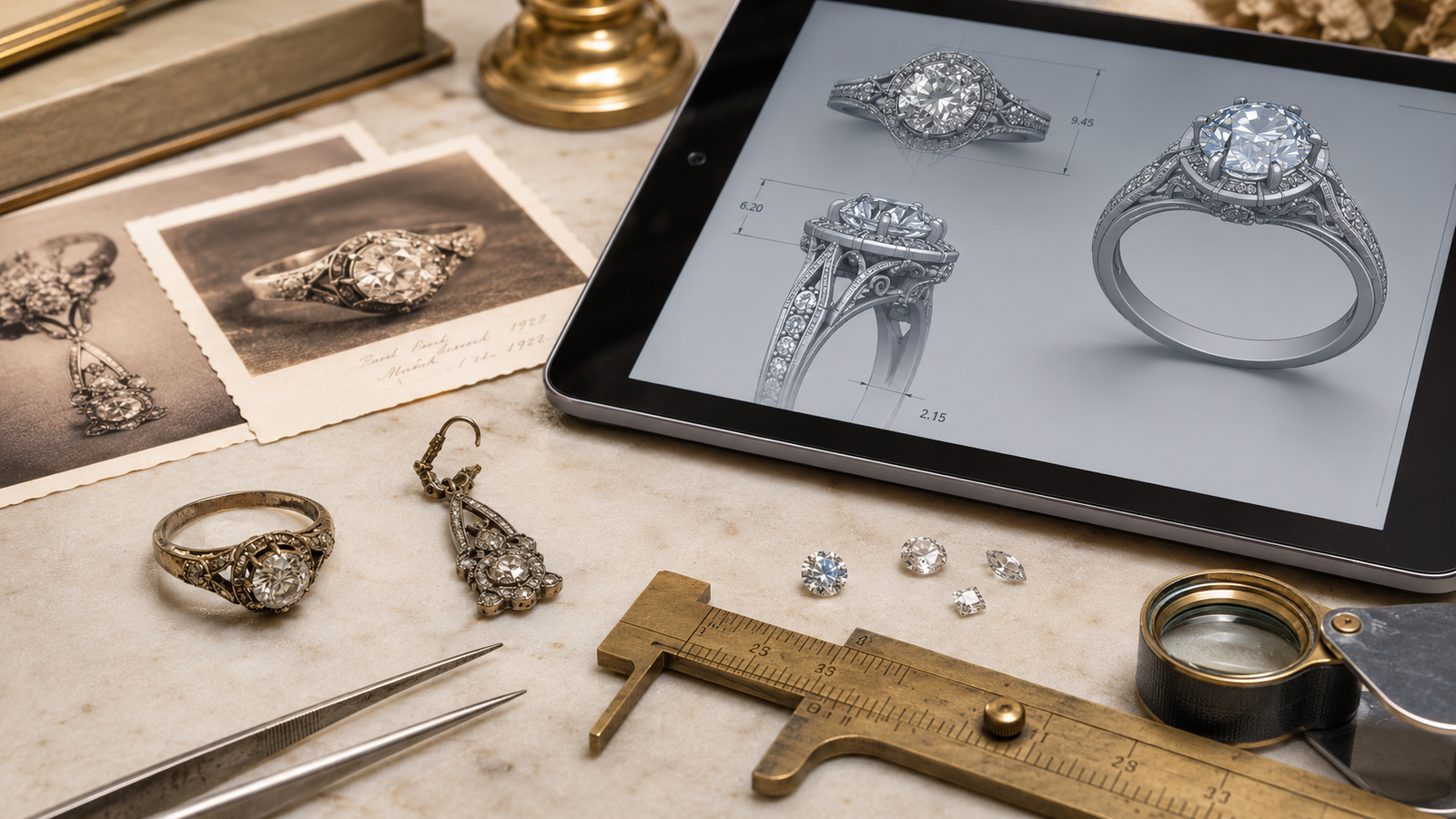
Accurate digital reconstruction begins with measurement. Calipers, photos, stone gauges, side views, top views, and physical inspection all become part of the process. If the piece includes gemstones, the designer must understand not only their visible size but also how they sit in the setting.
Rings often require special attention because their shape changes over time. A ring that has been worn for years may no longer be perfectly round. The shank may be thinner at the bottom, the shoulders may be slightly distorted, and the setting may have shifted. If these details are copied without interpretation, the new CAD model may carry old structural problems into a new production file.
Pendants create different questions. The front may look correct, but the thickness, back structure, and bail strength need careful checking. Earrings may require matching a lost pair, which means the remaining earring becomes the main reference. Even small differences in curve, stone spacing, or post position can affect whether the new piece feels like a true match.
This is one of the reasons jewelry CAD services for existing-piece recreation require patience. The work is not only about modeling what is visible. It is about understanding how the piece was made, how it has changed, and how it should be rebuilt for production.
Recreating Lost or Damaged Jewelry Without Losing Character
One of the most common requests in custom jewelry design is recreating a lost or damaged piece. Sometimes the client has only old photographs. Sometimes there is a matching earring, a broken fragment, or a similar piece from the same collection. In these cases, the CAD designer must rebuild the design from incomplete information.
This kind of work requires a balance between accuracy and interpretation. A photo may show the front view clearly but hide the side profile. A family ring may have visible ornamentation but no clear view of the gallery. A pendant may appear flat in a picture, even though the original had layered relief or curved surfaces.
3D jewelry CAD design gives the designer a way to reconstruct these missing areas logically. The model can be built in stages, reviewed from different angles, adjusted for proportion, and prepared for manufacturing. If needed, jewelry rendering can help the client compare the digital reconstruction with the available reference before production begins.
The most important point is restraint. A recreated piece should not become overdesigned simply because modern tools allow more detail. If the original had quiet elegance, the digital version should keep that spirit. If the original was bold and handmade, the CAD should not make it feel sterile. Technical accuracy matters, but so does emotional accuracy.
Redesigning Heirloom Jewelry for Modern Wear
Heirloom redesign is different from simple recreation. In these projects, the purpose is not always to copy the original piece. The client may want to preserve stones, metal, symbols, or family meaning while creating a new design that fits their current lifestyle.
For example, an old brooch may become a pendant. A dated engagement ring may be redesigned into a more wearable setting. Diamonds from several family pieces may be arranged into a new ring. A heavy old design may be reimagined with cleaner proportions while keeping its original stones.
This is where jewelry CAD modeling offers significant value. The designer can explore new arrangements without physically altering the original materials too early. Stone layouts can be tested, proportions can be refined, and the structure can be adjusted for daily wear. Engagement ring CAD is especially useful in heirloom redesign because older stones may have unique cuts, imperfect dimensions, or unusual depths that require custom seats.
Digital modeling also allows the client to make decisions with more confidence. Instead of relying only on verbal explanations, they can see how the inherited elements may look in a new form. Jewelry rendering can support this process by showing metal color, stone placement, and overall balance before the piece is made.
A successful heirloom redesign does not erase the past. It makes the piece wearable again.
Matching Existing Styles for Brands and Private Clients
Recreation work is not limited to personal heirlooms. Jewelry brands and manufacturers also need accurate CAD modeling when they want to expand an existing line, recreate discontinued designs, replace missing archive files, or create matching pieces for a collection.
A brand may have a popular ring and need matching earrings or a pendant. A manufacturer may need to rebuild an older model because the original CAD file is missing. A jeweler may need to create a wedding band that fits closely against an existing engagement ring. A private client may need one earring recreated to match the remaining one.
These projects require careful style matching. The new model must follow the visual language of the existing piece: edge softness, setting style, stone spacing, thickness, surface treatment, and overall proportion. If the CAD model is too sharp, too symmetrical, too heavy, or too modern, it may not match the original design even if the measurements are technically correct.
For matching wedding bands, the challenge becomes even more precise. The band must follow the engagement ring’s profile, allow proper clearance, and sit comfortably beside the existing ring. A straight band may not work against a low gallery or irregular halo. A curved band may need exact contouring to feel intentional rather than forced.
This kind of custom jewelry CAD is highly practical, but it also requires a trained eye.
When Modern Manufacturing Improves the Original
Recreating existing jewelry does not always mean repeating old production methods. Modern digital jewelry manufacturing can improve certain aspects of a design while preserving its look.
A weak area can be strengthened. A stone seat can be made more accurate. A ring can be resized with better internal comfort. A pendant can be given a stronger bail. A repeated pattern can be cleaned up. A model can be prepared for 3D printing and casting with more predictable results than the original handmade structure.
The key is to improve quietly. The client should not feel that the identity of the piece has changed unless redesign is part of the goal. Improvements should support longevity, comfort, and manufacturability.
For example, if an old ring had fragile prongs, the recreated CAD model can use slightly stronger prongs with a similar visual style. If a pendant had an uneven back that made it sit poorly, the new model can correct the weight and balance. If a design had decorative details that became too shallow over time, the CAD can restore their depth so they survive polishing.
In this way, 3D jewelry CAD design can act as a bridge between traditional craftsmanship and modern production standards.
The Role of Rendering in Reconstruction and Approval
Jewelry rendering is especially useful when recreating or redesigning existing pieces because clients often need to compare memory, reference images, and the proposed digital version. A realistic render can show whether the recreated model feels correct before it is printed or cast.
For brand work, renders can help compare the new CAD model with existing collection pieces. For private clients, they can make the approval process less uncertain. For manufacturers, they can clarify details before production begins.
However, rendering should be used carefully. The render should not make the piece look like a completely different object through unrealistic lighting, exaggerated stone brilliance, or overly polished surfaces. In reconstruction work, the purpose of rendering is not only glamour. It is clarity.
A good render helps answer practical questions: Does the proportion match? Does the stone layout feel correct? Does the new piece preserve the original character? Does the redesigned version still carry the intended emotional value?
When rendering supports accurate CAD rather than disguising it, the approval process becomes more trustworthy.
Conclusion: CAD as a Tool for Continuity
The recreation and redesign of existing jewelry requires more than technical modeling. It requires observation, restraint, judgment, and respect for the object’s history. A worn ring, a lost earring, a damaged pendant, or an inherited stone carries meaning that cannot be measured only in millimeters.
Professional 3D jewelry CAD design gives jewelers and manufacturers a precise way to preserve that meaning while preparing the piece for real production. Through careful measurement, thoughtful interpretation, jewelry CAD modeling, rendering, and digital manufacturing preparation, older designs can be rebuilt with greater accuracy and reliability.
For CADVANCE, this type of work reflects one of the most valuable roles of modern jewelry technology. CAD is not only used to create new luxury designs. It can also recover what was lost, strengthen what became fragile, and transform meaningful jewelry into pieces that can be worn again.
The strongest digital work does not always announce itself. Sometimes it simply allows a familiar design to return with the right shape, the right feeling, and the technical quality needed for a new life.