The Jewelry Digital Master: Connecting CAD, Manufacturing, Photo Rendering, and Video Across the Product Lifecycle
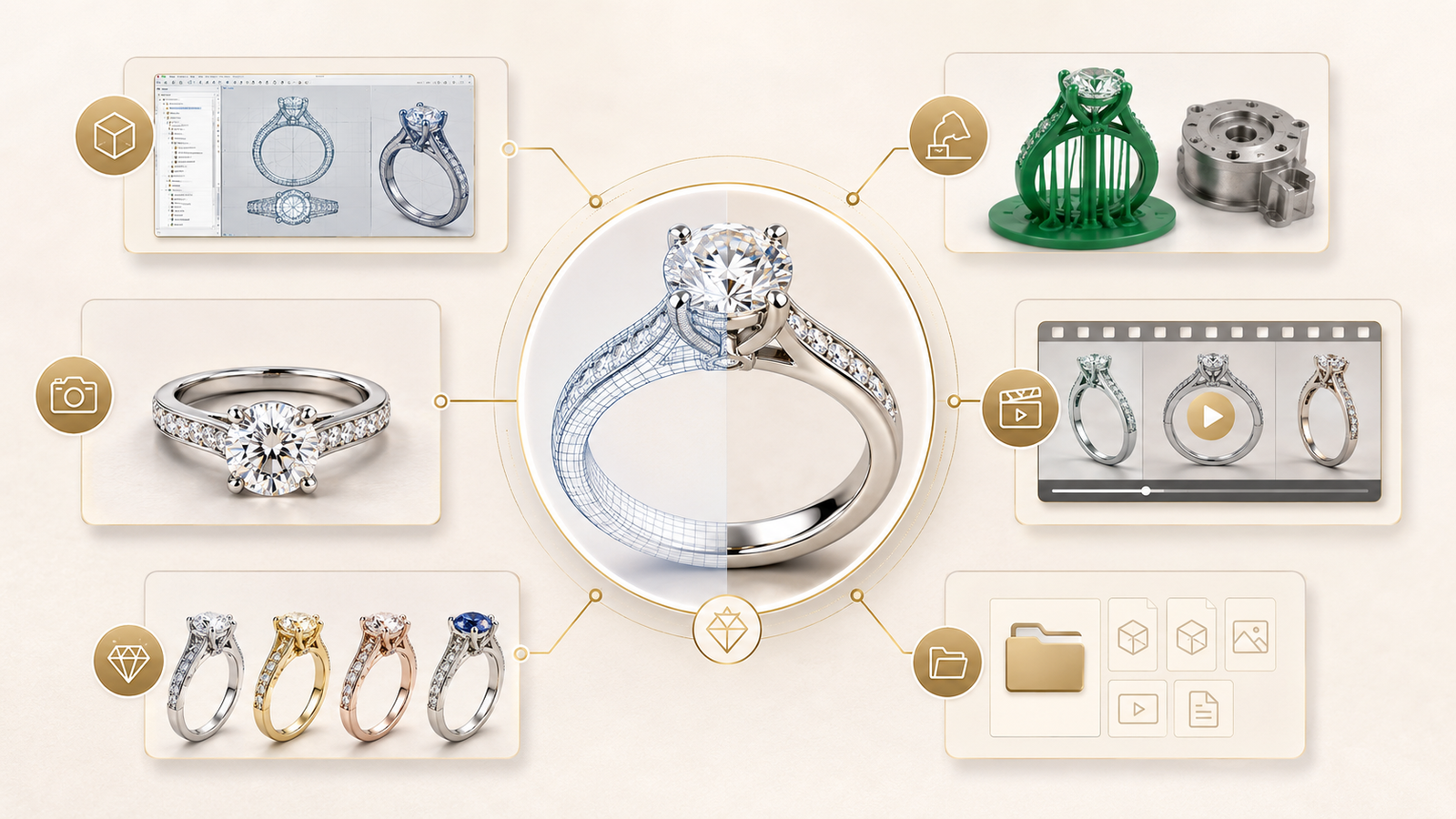
A jewelry design no longer needs to exist as a collection of disconnected files. The original concept, production model, client presentation, animation, manufacturing export, and product image can all originate from one carefully controlled digital source. When that source is accurate, organized, and formally approved, it becomes more than a CAD file. It becomes the digital master of the piece.
This approach is increasingly important for jewelry brands and manufacturers managing multiple collections, gemstone combinations, ring sizes, metal colors, and product launch schedules. Without a reliable digital master, small differences begin to appear between departments. A visualization team may work from an older model. A manufacturer may receive a file that does not include the latest setting revision. A campaign animation may show proportions that no longer match the finished jewelry.
Even when each individual file appears acceptable, the product gradually loses consistency.
Professional 3D jewelry CAD design can prevent that fragmentation. A disciplined master-model workflow connects jewelry CAD modeling, technical approval, photo and video rendering, 3D printing, casting, stone setting, and future product variations. The result is not simply faster development. It is a more coherent product identity from the first digital review to the final manufactured piece.
The Digital Master Is More Than a Production File
A production-ready jewelry model is often treated as the final result of the design process. In practice, it can become the beginning of a much larger product system.
The digital master should contain the approved proportions, gemstone dimensions, setting structure, component relationships, surface transitions, and manufacturing geometry of the piece. It should also be organized clearly enough to support future applications without rebuilding the design from the beginning.
For an engagement ring CAD project, the master may contain the center-stone setting, side-stone layout, gallery, shank, gemstone library, and sizing information. For pendant CAD modeling, it may include separate components for lettering, bail construction, stone settings, decorative surfaces, front structure, and back support. Multi-part jewelry may require individual components, assembly positions, and movement references.
This structure matters because different teams need different outputs.
The manufacturer may require an editable 3DM model and a carefully prepared STL file. The visualization artist may need separated metal and gemstone objects with logical material assignments. The brand team may require multiple photographic angles, transparent-background images, vertical social-media content, and a rotating product animation. The sales team may later request a rose-gold version, an alternative gemstone, or a modified size.
When the underlying model is reliable, each of these outputs remains connected to the same approved design. The digital master protects the original geometry while allowing controlled adaptation.
Version Control Protects the Design From Quiet Inconsistencies
Jewelry development rarely follows a perfectly straight path. A prong may be adjusted after feedback from the stone setter. The center stone may change. A pendant may be made slightly thicker. A clasp may be revised after prototyping. A shank may be resized, or a hidden connection may be strengthened before casting.
These changes are normal. The risk appears when revisions are not controlled.
A common production problem occurs when an obsolete model remains in circulation. A manufacturer may print version four while the client approved version five. A jewelry rendering may be created from an early file and then used on a product page after the physical piece has changed.
The differences may be subtle—a modified gallery, a stronger bail, a lower setting, or thicker connection—but they can still create confusion and weaken trust.
A master-model workflow requires clear revision logic. File names, dates, approval stages, and export status should be unambiguous. The approved manufacturing model should be immediately identifiable. Render geometry should be updated whenever a structural revision changes the visible design. Earlier versions should remain archived but should not compete with the current file.
This discipline is particularly valuable for international projects, where jewelry CAD modeling, visualization, printing, casting, and finishing may take place in different locations. Clear version control reduces dependence on memory and informal messages. It gives each participant a defined source of truth.
The purpose is not administrative complexity. It is design protection.
One Approved Model Can Support an Entire Visual Library
Traditional jewelry photography depends on the availability of a finished sample. Physical photography remains important, especially when the exact character of a gemstone, hand-applied finish, or final stone setting must be documented.
However, a controlled digital master can generate a visual library before every physical variation has been manufactured.
One approved model can support:
- High-resolution hero images
- Front, side, rear, and three-quarter product views
- Clean-background e-commerce imagery
- Close-up craftsmanship and stone-setting details
- Yellow, white, and rose gold variations
- Alternative gemstone combinations
- Vertical, horizontal, and square campaign formats
- Rotating jewelry animations
- Short-form product videos
- Assembly or feature demonstrations
The advantage is not simply the number of images produced. It is visual consistency.
Camera height, scale, lighting direction, material behavior, and product positioning can be coordinated across an entire jewelry collection. Matching earrings, rings, pendants, and bracelets can share the same visual language, even when their renders are created at different times.
Jewelry rendering also allows brands to evaluate which variations deserve physical sampling. A collection may be reviewed in several metal and gemstone combinations before production resources are committed. This does not replace manufacturing judgment, but it improves the quality of early commercial decisions.
The visual output must remain faithful to the approved jewelry CAD model. Prongs should not disappear for aesthetic convenience. Gemstones should not be enlarged artificially. Metal thickness and side profiles should correspond to the intended product.
When accuracy is maintained, rendered photography and animation become dependable extensions of the digital master rather than separate interpretations.
For brands requiring dedicated photorealistic images or motion content, CADVANCE also recommends its visualization partner, 4rend Studio, for professional jewelry rendering and animation projects.
Manufacturing Variants Should Be Designed, Not Automatically Scaled
A strong digital master makes product variation easier, but it does not make every variation automatic.
Ring sizing is a clear example. Enlarging or reducing an engagement ring CAD model can affect shank thickness, pavé spacing, stone count, gallery alignment, and the overall proportion of the ring. A simple scaling command may preserve the general silhouette while damaging the manufacturing logic.
Each size range may require controlled adjustment.
The same problem appears when a design is adapted for different center stones. A setting developed for a round diamond should not be stretched casually around an oval, cushion, pear, or unusually deep gemstone. The stone seat, prong positions, gallery height, and visual balance need to be reconsidered.
Metal changes can also influence production decisions. A design intended for platinum may require different technical choices from one manufactured in a lighter alloy. A large pendant offered in several metals may need a fresh weight and structural review rather than a purely cosmetic material change.
The digital master should therefore act as a parent model, not an untouchable template. It provides the approved design language and technical foundation, while each new product variation is developed as a controlled derivative.
This is especially useful for jewelry brands creating families of related products. A central motif may be adapted into a ring, pendant, earring, and bracelet, but every category has different requirements.
Pendant balance, earring weight, ring comfort, and bracelet movement cannot be solved through uniform scaling. Consistency comes from preserving the design intention, not from repeating identical geometry.
The Same Asset Can Serve Production, Sales, and Long-Term Archiving
Jewelry files often remain useful long after the original project is completed.
A client may request a replacement years later. A brand may revive an archived collection. A matching wedding band may be developed after the engagement ring has already been sold. A discontinued pendant may return with a different gemstone combination or a redesigned bail.
A well-maintained digital master makes these requests more manageable. The studio does not need to reverse-engineer its own work from screenshots, old renders, or an STL mesh that is difficult to edit. The design history remains available in a form that can be understood and modified.
This has commercial value, but it also has manufacturing value.
Archive files can preserve gemstone measurements, stone-setting logic, component construction, assembly information, and approved visual references. When repairs, remakes, or replacements are needed, the jeweler has more information than the finished object alone can provide.
The same archive supports marketing and sales. Existing CAD assets can be used to create additional jewelry rendering without photographing every product variation again. An animation can be updated for a new campaign. Product images can be reformatted for a marketplace, catalog, or social platform. A collection presentation can be refreshed without altering the underlying design.
The long-term usefulness of the asset depends on its quality. Disorganized geometry, missing stones, unclear revisions, and flattened exports reduce future value. Clean jewelry CAD modeling, sensible file organization, and accurate visualization preserve it.
A Reliable Workflow Requires Shared Standards
The digital-master approach only works when design, visualization, and manufacturing teams agree on what the file represents.
The CAD model must be technically credible. The rendering team should not alter important geometry without approval. The manufacturer must work from the confirmed production version. Changes made after prototyping, casting, or bench testing should be returned to the digital master rather than existing only in workshop knowledge.
Shared standards may include gemstone naming, layer organization, metal separation, measurement units, file formats, revision labels, camera conventions, and final approval responsibilities.
These details may appear operational, but they prevent expensive ambiguity.
For smaller jewelry businesses, the process does not need to become bureaucratic. Even a straightforward system can establish which file is current, which geometry was rendered, which model was released for production, and which changes were made afterward. The objective is traceability.
For larger brands and manufacturers, the master model can become part of a broader digital product library. Each SKU can be connected to its CAD source, image set, video animation, gemstone specification, manufacturing exports, and revision history. This creates a consistent foundation for future collection development.
Technology is most valuable when it reduces uncertainty. A disciplined digital jewelry workflow does precisely that.
Conclusion: One Controlled Source Creates a More Coherent Product
The modern jewelry product exists in several forms before it reaches the customer. It is a concept, a CAD model, a technical file, a printed pattern, a casting, a polished object, a product photograph, a video, and an archived digital asset.
When these forms are managed separately, differences accumulate. When they originate from one controlled digital master, the product remains coherent.
Professional 3D jewelry CAD design provides the geometry, but the wider value comes from how that geometry is managed. Version control protects design approvals. Jewelry rendering extends the model into accurate photo and video content. Controlled variations support collection growth. Organized archives preserve future manufacturing and commercial opportunities.
For CADVANCE, the digital master represents a mature approach to jewelry design, visualization, and production. It respects the precision of the workshop while recognizing that a piece must also be reviewed, presented, marketed, adapted, and preserved.
The strongest digital asset is not a file used once to produce a casting. It is a trusted source that continues to support the jewelry throughout its entire product lifecycle.